Okay, But… Podcast episode
Force: what are you asking the pull to do?
native controls, keyboard operable, no autoplay
One question: When a zipper resists, is pulling harder the only useful change?
What you'll explain: Identify a hand's pull and its direction, then explain why changing a zipper's working conditions can be more useful than increasing that pull.
A force is a push or pull. When you hold a zipper's tab and draw it along the opening, your hand supplies a pull to the slider. The slider's guiding passage brings the element rows into engagement or separates them as it travels. Your pull and the slider's shape have different jobs.
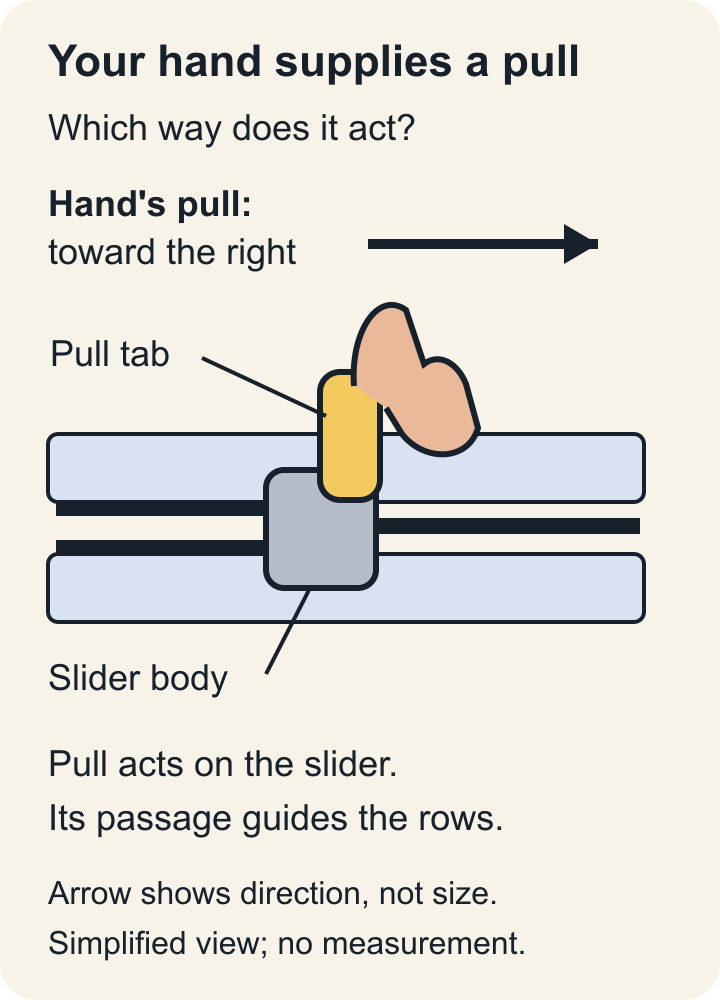
Diagram in words: A right-pointing arrow marks the hand pull on the tab and attached slider body. The zipper rows are guided by the body; arrow length is not a measured force.
The arrow shows the direction of the hand's pull on the slider. It doesn't show how large the force is. This is a simplified diagram, not a measured test.
Text equivalent: A hand holds the tab attached to a slider. The hand pulls toward the right along the zipper. That pull acts on the slider; its passage guides the rows. The arrow represents pull direction, with no numerical force or guaranteed outcome.
Think before adding more pull
Imagine an intact zippered supply pouch whose contents spread its two opening edges wide. No cloth is visibly caught in the slider. Which would address the described condition: keep hauling on the tab, or reduce the contents and bring the chain sides close before trying gentle normal closure?
You can consider the question without handling a pouch.
Answer and reasoning: Reducing the contents and bringing the chain sides close changes the loaded, spread-edge condition. Manufacturer guidance recommends this for an overfilled bag. A stronger pull asks the slider to overcome that condition as well as guide engagement; it isn't a universal solution. If cloth were caught in the passage instead, that would be a different problem. Avoid forcing either one. Stop if gentle normal movement fails or damage is apparent; this lesson isn't a repair guarantee.
A little more depth
An arrow can describe a force's direction without measuring its size. It also doesn't prove what will happen. A shape-guiding mechanism, caught material and the bag's packed condition still matter. Understanding “push or pull” helps you ask a better question: what conditions is this particular pull working against?
See it in action
In the paired zipper story, The Bag That Wouldn't Take One More Thing, Quinn removes an extra card packet and brings the bag's sides close before gentle closure. He changes the conditions in which the slider works rather than making the slider stronger.
Sources
NASA's Toys in Space II, glossary page 20 defines force as a push or pull. YKK's zipper mechanism explanation explains slider guidance. YKK's use precautions distinguish caught fabric and overfilled bags and support the bounded handling advice. These sources supply definitions and guidance, not a measured force or tested learner outcome.
Free worksheets for teachers and homeschoolers
Choose the student level you need. The answer key is a separate file.
- Middle school worksheet (PDF, 2 pages)
- High school worksheet (PDF, 3 pages)
- Teacher answer key (PDF, 3 pages)
Free to download and print for classroom or home use. No sign-up required.
Chapters
Chapters are added when the episode is published.
Transcript
The speaker-identified transcript is published on this page with the episode. A written adaptation of the audio is a separate piece with its own sources — not a copy of this transcript.
Episode credits
- Presented by
- Bridget Zayner
- Published
- Series
- Okay, But…
- Transcript
- Human-checked before publication