Okay, But… Podcast episode
The Bag That Wouldn’t Take One More Thing
native controls, keyboard operable, no autoplay
Okay, But How? — Quinn investigates a zipper before his project kit can leave the table.
Quinn had packed everything except the confidence with which he had offered to pack everything.
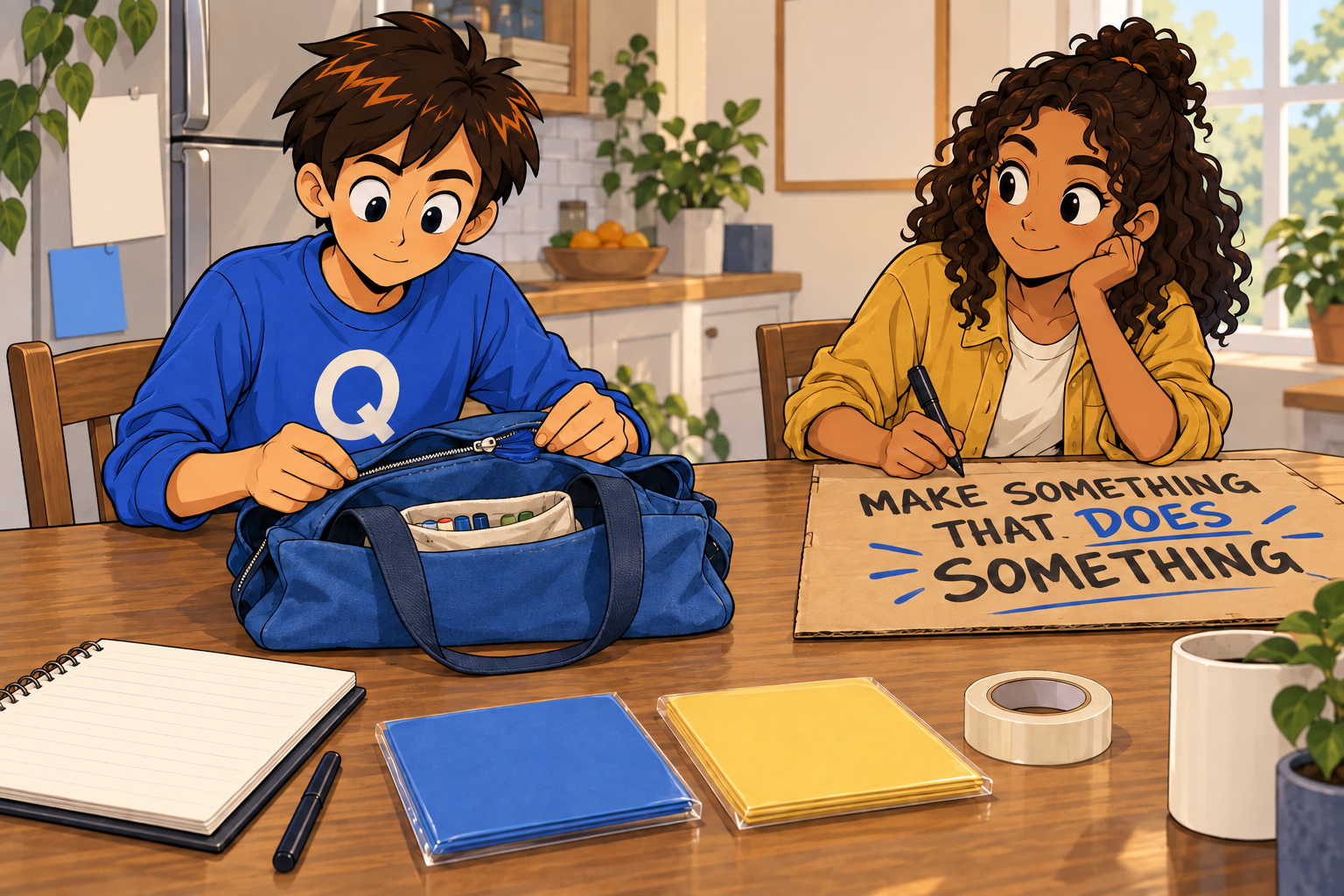
On the kitchen table lay a blue canvas bag, a notebook, two packets of card, a roll of tape and a cloth pouch of markers. Across the room, his friend Mara was making the cardboard sign for their afternoon project: MAKE SOMETHING THAT DOES SOMETHING.
“That includes the sign,” Quinn said.
“The sign tells people what to do.”
“Strong opening.”
They were taking a supply kit to the community room, where they had promised a table for building small cardboard contraptions. Quinn wanted to arrive carrying one sensible bag instead of trailing objects through the doorway like evidence of an accident. He had volunteered the old canvas bag because it had handles, a broad opening and a metal zipper that looked satisfyingly serious.
For now, he was just trying it with the marker pouch inside. He folded the pouch's soft flap down, drew the zipper pull along the top—and stopped.
The little metal body under the pull hadn't reached the end. It hadn't reached much of anything.
Quinn tried a slightly firmer pull. The blue lining lifted in a tight wrinkle. He let go.
Mara looked up from her sign. “Did you pack the table?”
“It's catching on something.”
“Already?”
There were far more things waiting outside the bag than inside it. That made this feel personal.
Quinn set the bag flat instead of holding it by the handles. He wanted to get moving, but he also wanted the bag to survive being useful. The metal teeth were intact as far as he could see. A narrow fold of lining had followed them into the moving body.
He could pull the tab farther, or change what was going into that body. The wrinkle made a small, pointed argument for the second option.
Keeping his fingers clear of the opening, he eased the slider back a little and slowly worked the loose lining away. When the fold came free, he held it aside and moved the slider gently along the same stretch. This time it travelled.
Mara resumed lettering. Quinn did not resume packing.
He had been blaming the part he could hold. Now he wanted to know what that part was actually doing.
A tiny moving workshop
He opened the bag again, carefully keeping the lining out of the route. Two rows of metal teeth separated behind the slider. Closing it joined them again. The canvas edges stayed flexible; the slider stayed the same small size.
Quinn stopped halfway.
“Look at that.”
Mara leaned across the table. “The bag?”
“The part it's already passed.”
Behind the slider, a joined chain stretched along the opening. Ahead of it, the teeth still belonged to two separate rows. The slider was touching only a short section, yet the rest stayed joined after it moved away.
Quinn had vaguely pictured the slider squeezing the edges together. That would explain the bit underneath it. It left the long closed bit with nobody in charge.
He traced the joined section with a hovering finger. No slider there. No strip of glue either. Whatever held those teeth together had to remain in the teeth themselves.
Before he moved it again, he pictured the hidden route. Two separate rows had to become one joined chain. Then, when he reversed direction, that chain had to divide. What sort of passage could let the same little object do both jobs?
He drew two lines on a scrap of card. Mara, watching, brought their ends together with her pencil.
“Like a fork in a road?” she said.
“Depending which way you're going.”
They couldn't see through the bag's metal slider. Quinn looked up a manufacturer explanation and a drawing of an older metal fastener design. The cutaway gave their pencil fork a more precise shape: inside the slider was a Y-shaped passage, with two branches and a single joined route.
The fabric strips carrying the rows are called tapes. The teeth are also called elements. The part Quinn held was the pull tab, attached to the slider body that enclosed the guiding passage.
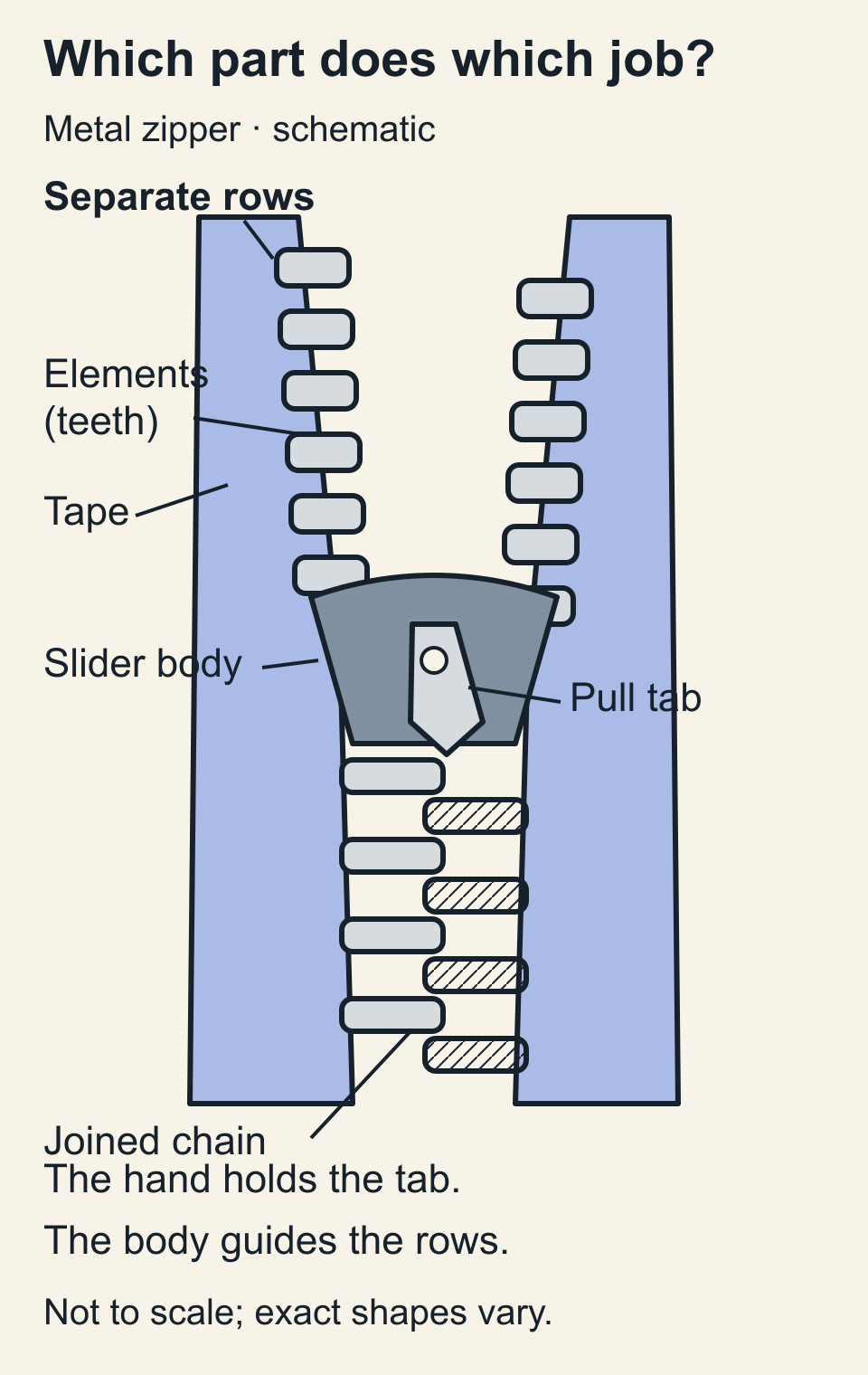
Diagram in words: A pull tab attaches to the small slider body; two fabric tapes carry the element rows, joined on one side of the slider and separate on the other.
In closing, the slider's passage guided the two separate rows into engagement. In opening, the dividing part of that passage guided the engaged rows apart. Reversing the slider changed which job the same route performed.
Quinn rotated his scrap of card sideways, matching the bag on the table. The fork still worked. “Up” and “down” weren't the important directions. Opening and closing were.
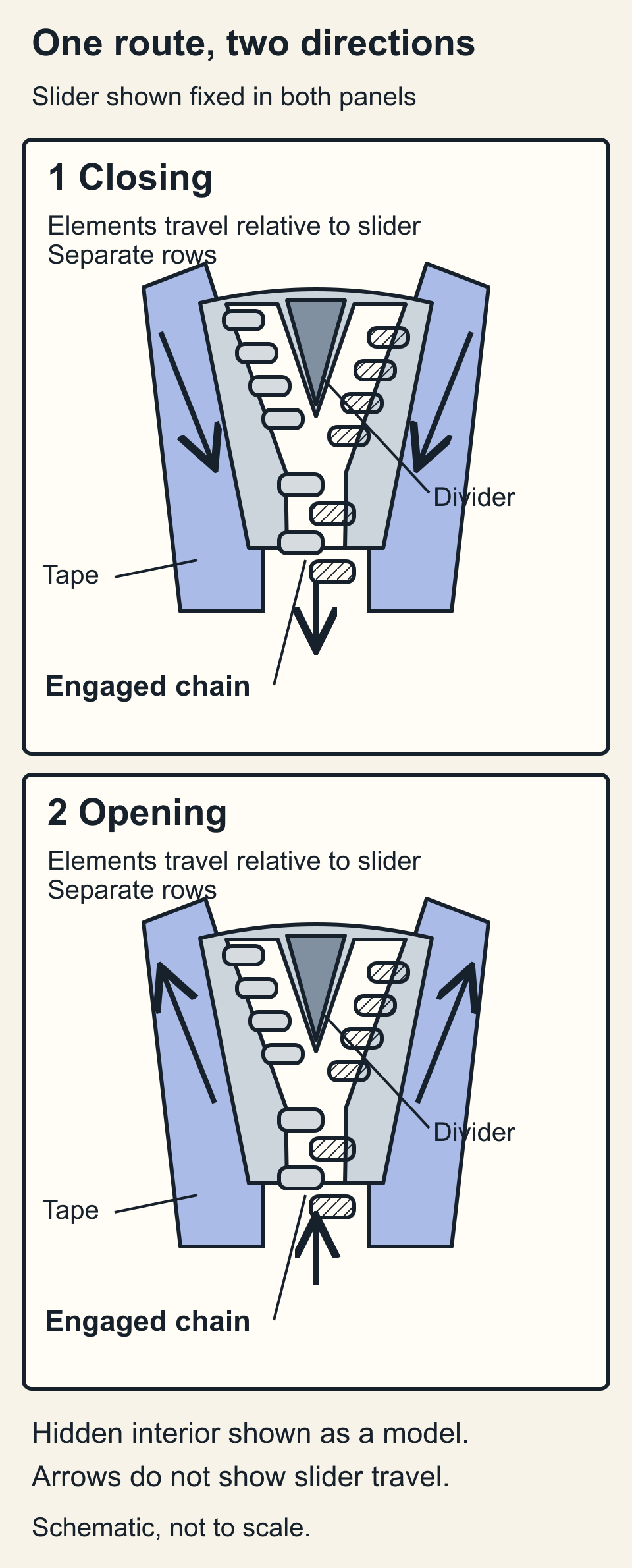
Diagram in words: Closing: separate rows travel through two branches into engagement at the single route. Opening: the engaged chain travels the reverse way and divides into the branches. Both panels show elements moving relative to a fixed slider.
“So this thing doesn't sew,” Quinn said.
“Disappointing. We still need a sign.”
“It arranges.”
He moved the bag's slider a short distance again, watching the change immediately beside it. His hand supplied a pull—a force, meaning a push or pull. The slider's shape guided the rows. It wasn't just squeezing indiscriminately wherever Quinn happened to tug.
That made the lining fold more interesting, and his firmer pull less impressive. He'd been asking a narrow guiding passage to accept an extra passenger.
The part left behind
The route explained the moving join. It still didn't quite explain why the join stayed.
Quinn enlarged the metal fastener drawing. In that design, teeth from opposite rows alternated along the chain. A projection on one element fitted into a recess—a hollow—on a neighboring element. Their shapes nested together. The closed chain wasn't two identical combs pressing tip to tip.
He added short offset marks to his fork sketch, then crossed out the two perfectly opposing rows he'd first drawn.
“My first version was two combs having an argument,” he said.
“Did either win?”
“They were both wrong.”
The enlarged drawing was a model of a particular metal design, not a claim that every zipper had those exact little hollows. Coil zippers use a different construction. Here, though, the model answered the question he had: the slider guided the elements into a fit that remained after it passed. Carefully fitted rounded shapes in that design allowed flexibility while retaining engagement. The slider didn't need to occupy the whole closed length.
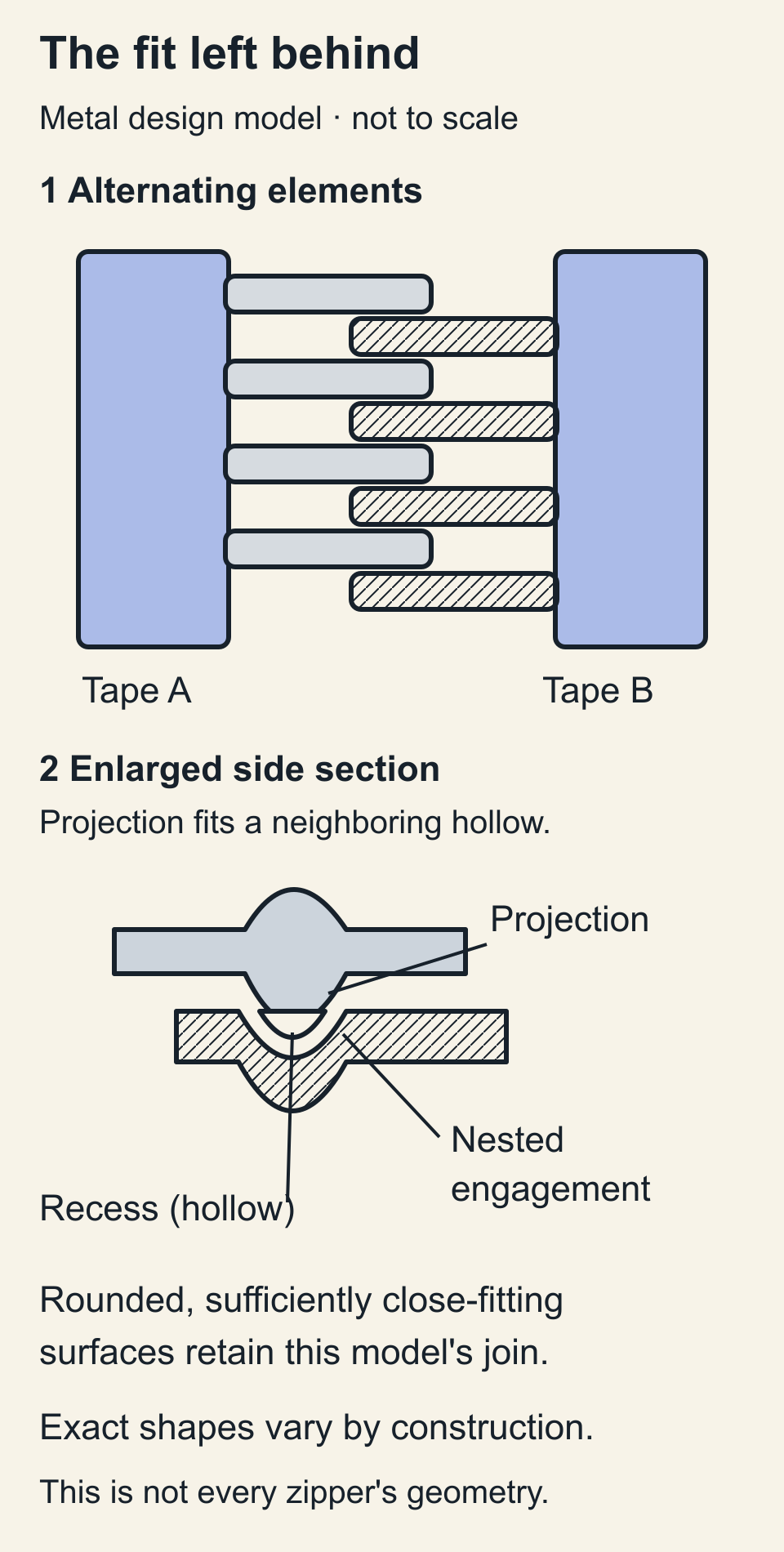
Diagram in words: Elements from opposite tapes alternate. A rounded projection fits into a neighboring recess in this enlarged metal-design model; exact element shapes differ across zipper constructions.
Quinn closed the mostly empty bag, then opened it again. He wasn't checking whether a drawing made this bag indestructible. He was following where the separate rows changed into the joined chain, and where the reverse journey undid that change.
Mara had finished the sign. Quinn's pile had not become smaller.
“Your bag investigation does something,” she said. “Our kit still doesn't go anywhere.”
He looked at the waiting card packets. “Right. Packing.”
One more thing
The notebook went in flat. The markers fitted beside it. Quinn tucked the tape into the gap, then added one packet of card.
That left the second packet.
They had chosen two colors so people could make contrasting parts. Leaving one behind felt like giving up on a good plan for a small and embarrassing reason. Quinn stood the second packet along the side of the bag and pushed the soft top edges toward each other.
They sprang apart when he let go.
Mara held up the sign. “This too?”
Quinn looked at her. Then at the bag. Then at the sign, which was wider than both of them had sensibly remembered.
“That gets its own transport arrangement.”
“Me.”
“An excellent arrangement.”
He kept the lining clear and began closing the zipper. Near the bulky card packet, the two sides of the opening spread wide. The slider resisted. He stopped immediately.
For a moment, his hand prepared to repeat the trick that had worked before. Ease back. Find the cloth. Release it.
But the visible route was clear. No wrinkle disappeared into the slider. The bag was bulging against the opening, and Quinn had been using the pull tab to draw two loaded edges together.
Same bag. Same slider. Different problem.
Mara put the sign down. “More lining?”
“I don't see any caught this time.”
He loosened his grip on the tab and looked along both tapes. Moving surfaces can resist sliding; that contact resistance is friction. But “it resists” didn't tell him that friction explained the whole trouble. Earlier, cloth had occupied the passage. Now the contents were spreading and loading the sides he needed the passage to guide together.
Pulling harder would ask the slider to overcome the packing problem as well as do its ordinary guiding job. What could he change before asking it to move?
Quinn opened the bag gently and took out the extra packet.
He hesitated with it in his hand. This had been his plan: everything in one bag, ready to carry. Removing something felt less like a solution than an admission.
“We wanted two colors,” he said.
“We wanted people to make things,” Mara said. She tapped the first packet. “There is still card.”
He set the second packet with the sign. “You can carry these together?”
“My transport arrangement accepts an upgrade.”
With fewer contents, Quinn could bring the zipper's two sides close without hauling them together by the pull tab. He kept the lining away from the passage, held the opening in a comfortable position and drew the slider gently along it.
The chain joined. This time he watched the fit form behind the moving body instead of celebrating the tab reaching the end.
He hadn't made the slider stronger. He had changed the conditions in which it worked.
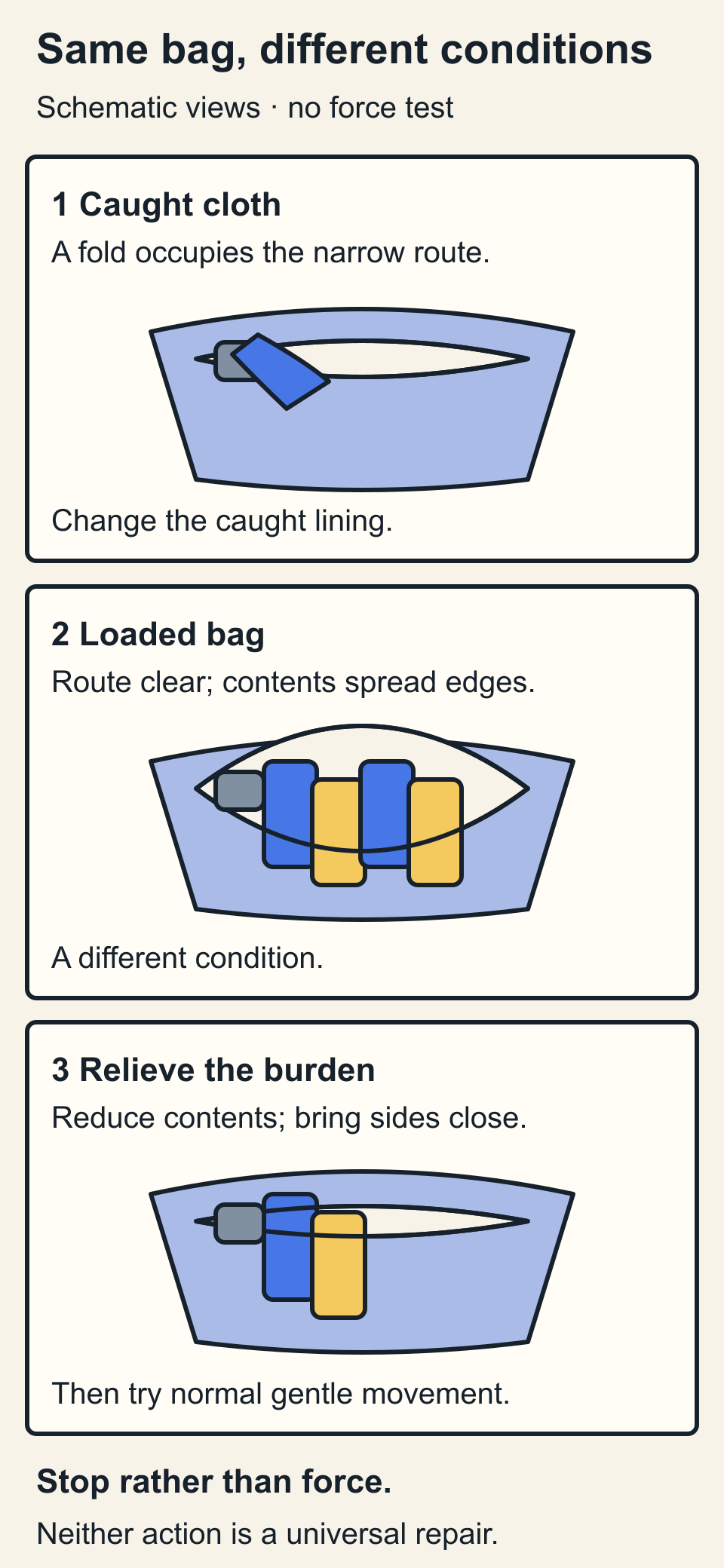
Diagram in words: First, a lining fold occupies the slider path. Later, the path is clear but packed contents spread the zipper edges. Removing contents allows the sides to be brought close before gentle closing.
Manufacturer guidance recommends reducing the contents of an overfilled bag and bringing the chain sides close before closing. That supports Quinn's choice, without promising every resistant zipper will recover. If gentle normal movement fails, or parts look damaged, stop rather than force it. A good explanation is useful without becoming permission to wrestle every broken object into agreement.
Out the door
Quinn lifted the bag by its handles. Mara took the sign and extra card. They had a kit they could carry, although it required two people and a small revision to Quinn's idea of “everything.”

At the doorway, he glanced back at the table. His fork sketch was still there, offset marks straggling along both sides.
“Bring that?” Mara asked.
He folded it into the notebook pocket before closing the bag gently again.
“It does something.”
“It explains the bag.”
“And why you have the other card.”
The little slider no longer looked like a handle attached to a stubborn seam. It was a moving guide, bringing shapes into engagement and separating them again. The bag's closure made sense. So did stopping when its working conditions changed.
As they set off, Quinn noticed the pull tab lying against the slider body. Some sliders have locks that help prevent unwanted travel. Guiding the chain and keeping the slider from wandering were two different jobs.
He had a possible next investigation: how can a pull tab help release a slider lock? First, though, they had a table to set up—and a sign that did something.
The short route: what a zipper does
A slider guides two rows of elements into engagement to close a zipper, and guides them apart to open it. Its Y-shaped passage provides two branches and one joined route. In the metal model explained here, alternating projections and recesses retain the connection after the slider moves away. Other zipper constructions have different element shapes.
Your hand supplies a pull. The slider's shape supplies guidance. Keep unwanted cloth out of its route; for an overfilled bag, reduce the contents and bring the chain sides close before closing. Stop at resistance or apparent damage rather than forcing movement. These are handling choices, not a promise of repair.
Go a little deeper: guidance, friction and fit
The slider and the elements move relative to one another. On the bag, you move the slider along the tapes. In a cutaway drawn with the slider held still, arrows can instead show the elements travelling through it. Those are two ways of describing relative motion; an arrow for one must not be mistaken for an arrow for the other.
Friction opposes relative sliding at contacting surfaces. Its size depends on the surfaces and how they are pressed together. This helps explain why sliding conditions matter, but gives no numerical force prediction for this bag. It also doesn't turn every blockage into a friction problem. Unwanted cloth, widely spread loaded edges and incompatible or damaged shapes require different questions.
Retaining the chain's engagement is another relationship again. In the bounded metal model, projections nest into neighboring recesses. Shape and fit explain that connection; “friction glues the teeth together” would miss the mechanism. Some sliders additionally have locking mechanisms that restrict slider travel. Those locks vary by type and don't mean every zipper requires the same pull-tab position.
Sources behind the mechanism
- YKK's explanation of zipper parts and the Y-shaped slider passage supports the parts, guided joining/separation and importance of shape and fit.
- Gideon Sundback's original metal fastener patent, US1219881A supplies the particular alternating projection-and-recess model used here. It is a design record, not a test of Quinn's bag or a description of every modern zipper.
- YKK's zipper-use precautions support avoiding force with caught fabric and reducing the burden and bringing chain sides close on an overfilled bag. Coats' invisible-zip technical brochure, especially its best-practice table, independently describes the need for slider clearance; its sewing instructions concern that specific zipper type.
- NASA's Toys in Space II glossary, page 20 and NASA's Flight Testing Newton's Laws, section 4.9 support the force and friction foundations. They supply physics context rather than zipper tests.
- YKK's explanation of slider locks supports the next question and distinguishes particular locking types.
Optional: educator and homeschool companion
Explore the zipper with Quinn
Companion to The Bag That Wouldn't Take One More Thing, OBH-002, story version 1. Intended for discussion with middle and high school readers; the simpler route can support different experience levels. No activity duration or curriculum alignment has been tested or claimed.
What learners will explain
Ask the learner to explain how a moving slider guides separate rows into engagement, why the bounded metal-model chain can remain joined behind it, and why a clear but overfilled bag calls for a different choice than caught cloth. Listen for the relationship between guiding shape and working conditions, rather than exact terminology alone.
No earlier episode is required. Learners need only distinguish a moving part from a stationary one and follow “ahead of” and “behind” relative to a chosen direction. Supply those meanings by pointing to a drawing before asking for an explanation. The story introduces force and friction locally. The separate force lesson is an optional closer look after the story. Friction is explained here; no separate friction lesson is required.
Vocabulary at the moment it matters
- Tape: fabric strip carrying one row of elements.
- Elements/teeth: the repeated parts along the two tapes that engage and separate.
- Slider body / pull tab: the guiding body and the attached part the hand holds; they have different jobs.
- Engagement: elements fitting together. Projection / recess: a sticking-out part and a hollow receiving it in the particular metal model.
- Force: a push or pull. Sliding friction: contact resistance opposing relative sliding. It does not name every possible obstruction or failed fit.
- Relative motion: movement of one part compared with another. You can describe a slider moving along a chain or a chain passing through a fixed slider; keep arrows consistent with the chosen viewpoint.
Before giving away the answer
During “A tiny moving workshop,” pause after Quinn wonders what passage can join and divide the rows, before the manufacturer drawing. Ask: “What would the route need to let two rows do? What changes when the motion reverses?” Let the learner sketch or explain verbally. Accept a branching idea without requiring a perfect Y. If someone predicts a clamp, ask what holds the section the slider has already left. Continue reading even if no prediction is offered.
During “One more thing,” pause before Quinn removes the packet. Ask: “What evidence differs from the first stall? Which condition could he change before touching the tab again?” Avoid suggesting the contents until the learner has compared the lining, passage and spread edges.
Observation: ahead and behind
This is a proposed ordinary-item observation, not a tested repair activity.
Materials: one intact empty pencil case or spare garment with an attached zipper; a table; paper and pencil for optional recording. A magnifier is optional. An adult checks beforehand for smooth normal movement, sharp/damaged parts and loose small pieces. Choose a closed-end item to avoid separating-jacket startup becoming another task. No zipper should be removed from its item.
Preparation: read the story and identify the two rows, slider body and tab. Remove contents; lay the item flat. Check that lining and loose threads are clear. Choose a comfortable orientation and agree which movement opens and which closes. Do not assume upward always closes.
- Without moving anything, describe or sketch which chain section is joined and which is separate. If the case is fully closed, an adult may open a small section normally first.
- Predict where the state will change when the slider moves gently a short distance toward closing.
- Move it normally and gently, keeping fingers and hair away from the moving passage. Stop immediately at resistance. Observe just ahead of and just behind the slider; keep fingers out of the passage.
- Reverse gently and compare. Keep the same item, orientation and empty condition; the intended change is direction of relative movement.
- Record what is visible and what is inferred from the schematic. Explain why the closed section can remain joined away from the slider in the metal model.
Expected range: learners may see joined versus separate rows readily while individual element shapes remain too small to resolve. A coil zipper may not resemble the metal detail. Record the actual visibility and construction rather than inventing a projection/recess observation. If motion resists or looks abnormal, stop using the item and use the diagram route below. That is a setup limit, not a learner failure.
Safety: never deliberately catch lining, add objects to the passage, overload a bag, pull the chain sides apart, remove stops or detach small components. Do not use blades, pliers, heat or lubricants. Exclude damaged/sharp items. Keep younger siblings away from loose small objects; the attached intact case or paper route avoids handing them detached zipper parts. An adult handles any item unsuitable for the learner; no physical operation is required to participate.
Limits: visible state changes support observation of joining/separation. They cannot expose an opaque slider's interior, measure forces/friction/strength, demonstrate an exact patent geometry or prove a repair works. The diagram explains hidden relationships as a model. Normal movement is not permission to test failure.
Paper or verbal route
Diagram in words: Closing: separate rows travel through two branches into engagement at the single route. Opening: the engaged chain travels the reverse way and divides into the branches. Both panels show elements moving relative to a fixed slider.
Diagram in words: Elements from opposite tapes alternate. A rounded projection fits into a neighboring recess in this enlarged metal-design model; exact element shapes differ across zipper constructions.
Use the story's closing/opening diagram or describe two branches meeting one route. The learner traces separate rows toward engagement for closing, then describes the reverse division for opening. Mark projection and recess on the bounded metal detail; identify them by label and outline, not color alone. No cutting or small loose tokens are needed. For an entirely verbal route, have the learner describe where the rows are separate, where guidance happens and where the joined chain remains.
This preserves the central explanation without materials, technology or fine motor action. It is interpretation of an explanatory model, with less direct evidence than observing an actual intact item. The diagrams and their text equivalents accompany this activity.
Discussion and transfer
- Quinn expected a squeezing slider to explain closure. What did the section behind the slider make him reconsider?
- In the metal model, which feature performs guidance, and which feature retains engagement after guidance?
- What changed and stayed constant when Quinn opened and closed the mostly empty bag?
- An ordinary zippered pouch has no visible cloth in the passage, but its contents spread the opening wide. Would repeating the caught-cloth action address that observation? Describe a supported next choice and a stopping condition, without trying it.
- A second zipper has coil elements rather than the metal model's hollows. What can you still explain with the Y-route idea, and which exact-shape claim should you withhold?
- Why isn't “friction” enough of an explanation for every resistant slider? What observation would make you ask about obstruction or loaded edges instead?
Answer guidance and tempting alternatives
- The joined length is away from the small slider. A continuous-clamp explanation can't account for that whole section. A learner saying “the teeth lock” has the right direction; ask how the model's shapes accomplish that fit.
- The slider's passage guides the rows. Alternating projections and recesses retain connection in the particular metal design. Avoid claiming the slider glues them or that contact friction alone retains every tooth. Compatible fit matters; the chain isn't indestructible.
- Same slider, chain, clear lining and mostly empty condition; direction changes. Closing produces engagement; reversal guides separation. Rotating the whole item changes “up/down,” so direction labels should be opening/closing relative to the chain.
- Cloth release addresses unwanted material in the route. Wide loaded edges are different. Manufacturer guidance supports reducing contents and bringing chain sides close before gentle closure. Stop if normal gentle movement fails or damage appears. “Inspect first” is also acceptable: the information doesn't diagnose every real failure.
- General guided joining/separation remains available. Exact alternating cup/projection/recess geometry belongs to the stated metal model; a coil needs its own construction evidence. Recognizing this boundary is useful reasoning, not an incomplete answer.
- Friction names contact sliding resistance. A fold physically occupying the route or contents spreading/loading the edges requires additional explanation and different actions. Don't insist a learner must isolate a numerical friction contribution; this setup cannot do so.
Other tempting ideas: “harder always works,” because motion needs force; respond by comparing what the pull is being asked to do under each condition. “Up means close,” because jackets commonly sit vertically; turn the drawing sideways. “All pull tabs lock the same way,” because some sliders have locks; distinguish preventing slider travel from retaining the joined chain and leave type-specific operation to applicable guidance.
Unexpected answers: ask the learner to point to the observation supporting their account. If the item cannot show it, separate “I saw…” from “the model explains…”. Record uncertainty. Do not treat Quinn's successful bag as a test result or require the learner's item to reproduce it.
One learner, siblings or a group
For one learner, an adult reads only the pre-reveal prompt, listens to a sketch/verbal prediction, and lets the learner inspect the available item or diagram. Use “What makes you think that?” and “Which part remains joined?” before naming a mechanism. Then read the reveal together and revise the initial sketch.
For siblings or mixed experience, let one describe visible states, another track motion, and another distinguish evidence from model. Rotate roles; do not make the most experienced person give the answer first. A younger sibling can point to joined/separate states in a large diagram while the older learner explains retained engagement and limits. Physical handling can remain with the adult.
For a classroom or small group, pairs can compare sketches using a single shared diagram instead of needing an item each. Ask groups to report both an explanation and one thing the activity cannot establish. No competition for fastest closure is needed.
Simpler adaptation: use only the joined/separate comparison, three part names and one Y route; introduce projection/recess through labeled shapes after the route is clear. Deeper adaptation: ask learners to rewrite motion labels for a fixed-slider viewpoint and identify why a friction coefficient or safe-force number cannot be calculated from this observation. Neither route requires formulas or a chain of prior lessons.
Evidence and continuing curiosity
Use the source notes at the end of the paired story: YKK for contemporary guidance and practical limits; the original Sundback design for the specific metal model; Coats for independent type-scoped clearance evidence; NASA for force/friction definitions. The activity is a conservative proposed observation derived from that bounded evidence, with no measured duration or learning result.
Optional further question: how does a pull tab release a lock in particular slider types? That is a proposed investigation, not a promise that every tab operates identically. The separate force lesson is optional; the force and friction explanations above remain available offline.
Free worksheets for teachers and homeschoolers
Choose the student level you need. The answer key is a separate file.
- Middle school worksheet (PDF, 3 pages)
- High school worksheet (PDF, 3 pages)
- Teacher answer key (PDF, 5 pages)
Free to download and print for classroom or home use. No sign-up required.
Chapters
Chapters are added when the episode is published.
Transcript
The speaker-identified transcript is published on this page with the episode. A written adaptation of the audio is a separate piece with its own sources — not a copy of this transcript.
Episode credits
- Presented by
- Bridget Zayner
- Published
- Series
- Okay, But…
- Transcript
- Human-checked before publication