Okay, But… Podcast episode
Fair, Repeated Trials
native controls, keyboard operable, no autoplay
OKAY, BUT… HOW? · A closer look
Question: How can you tell whether a changed release point helps?
You’ll be able to: Plan a comparable repeated trial, record every outcome and identify a remaining limitation.
Decide your question before releasing the marble: does changing the release mark affect whether it stays in the cup? Name what you change and what you observe.
For this comparison, keep the marble, track, cup and let-go method as steady as you can. Repeat both release settings and record every result, including misses. If the track shifts, record that too: an uncontrolled change can confuse the comparison.
Repeated trials reveal variation. They do not guarantee a universal rule or remove every error. A consistently crooked ruler can give consistently wrong measurements. Changing one factor is useful here; more complex experiments can deliberately study several factors together.
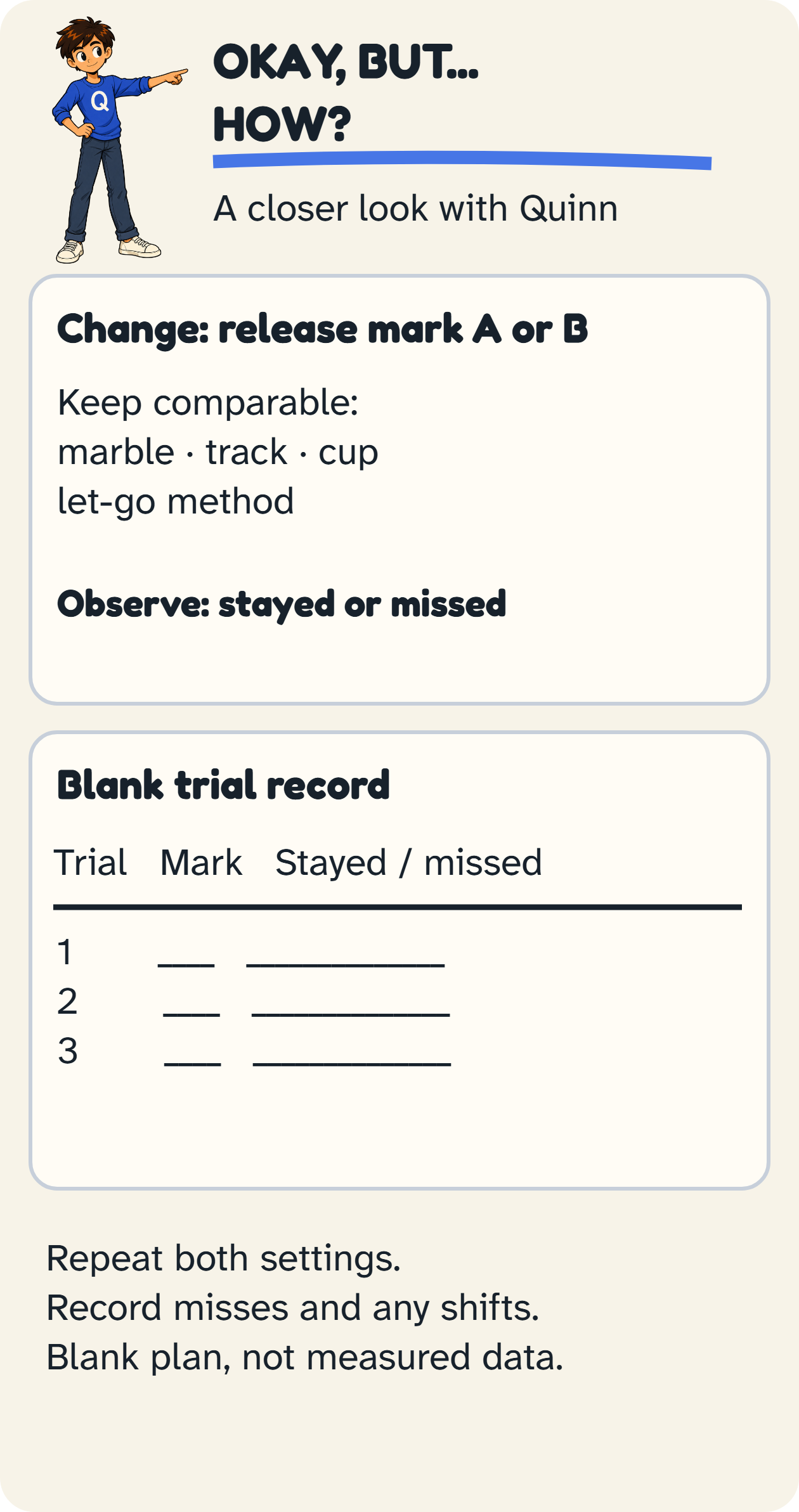
Diagram in words: Below Quinn’s branded header is a trial plan. Only the release mark changes between A and B; marble, track, cup and release method stay comparable. A blank table has trial, release mark and stayed or missed columns, followed by a reminder to record changes.
Open the full-resolution diagram
Try the idea
A release gives one catch. The next trial misses after the track shifts. Should you delete the miss?
Answer: No. Record the miss and the shift. It is useful information about the conditions. Compare repeated trials of both settings, and do not present a shifted track as an unchanged comparison.
A little further, if you want
Optional observation: use an existing low, stable cardboard track, books, tape, one marble and a catching tray. No tools, tall runs, stairs or roads. Keep the marble away from young children and pets; never put it in your mouth. Diagram reasoning needs no materials. No outcome is promised.
See it in action
One More Take — Quinn repeats low and high releases, then checks the changed lower-shelf arrangement before filming.
From the story? Return to One More Take at this concept. Arrived directly? Browse Okay But stories. Normal browser Back returns you to your previous page.
Sources
- NIST: What is experimental design? — Planning factors and responses.
- NIST: Variability — Variation in repeated measurements.
- NIST: Measurement terminology — Repeatability and random/systematic errors; D.1.1.2–6.
- Exploratorium: Marble Machines Activity Guide — Practical slowing features, securing pieces and repeated tests; pages1–5.
Download this lesson with its diagram and answer (PDF)
Free classroom worksheets
Use this lesson in class or at home with separate student worksheets and a teacher answer key. All three PDFs are free to download, with no sign-up.
Chapters
Chapters are added when the episode is published.
Transcript
The speaker-identified transcript is published on this page with the episode. A written adaptation of the audio is a separate piece with its own sources — not a copy of this transcript.
Episode credits
- Presented by
- Bridget Zayner
- Published
- Series
- Okay, But…
- Transcript
- Human-checked before publication