Okay, But… Podcast episode
Finish Speed versus Arrival Time
native controls, keyboard operable, no autoplay
OKAY, BUT… HOW? · A closer look
Question: Can two journeys end at the same speed but take different amounts of time?
You’ll be able to: Distinguish speed at the finish from elapsed time over the whole route.
Finish speed asks how fast the marble is moving at one place. Arrival time asks how long the whole journey took, from release to that place. A finish-speed comparison cannot tell you every part of the journey.
For the same marble let go without a push, rolling without skidding and with no energy losses, equal drops give equal ideal finish speeds. Different route shapes can still produce different journey times. Time depends on how the marble moves all along the route.
Harvard describes a ball race in which a curved route beats a straight incline. That is a specific demonstration, not a rule that every curve wins. A homemade track needs timing rather than a guess based on its length.
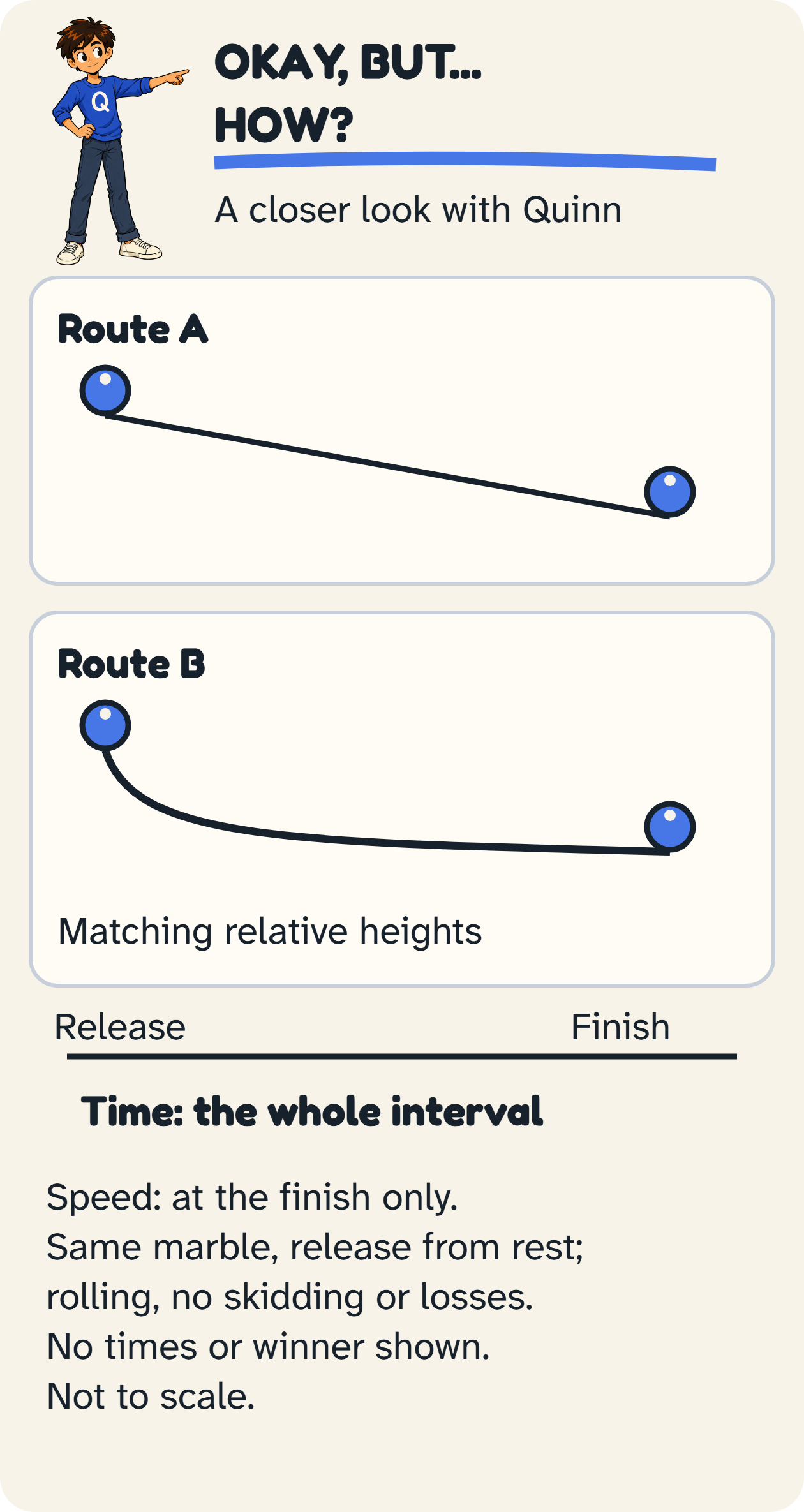
Diagram in words: Two stacked route panels have equal relative endpoint heights but different downhill profiles. A separate timing strip marks release to finish, while separate text identifies speed at the finish. No times or winning route are claimed.
Open the full-resolution diagram
Try the idea
You know two ideal runs have equal finish speeds. Can you announce a tie in arrival time?
Answer: No. Equal endpoint speed does not tell you the speeds throughout either route. You need the journey times to decide whether they tie.
A little further, if you want
Optional: Illinois derives the time distinction for a particle sliding without friction. That is not the spinning-marble speed model. It illustrates why a whole-path question needs more information than endpoint heights.
See it in action
No published Okay But story currently demonstrates this concept as a separate application.
From the story? Return to One More Take at this concept. Arrived directly? Browse Okay But stories. Normal browser Back returns you to your previous page.
Sources
- Harvard: Brachistochrone demonstration — A described curved-versus-straight ball race.
- Illinois: Brachistochrone teaching notes — Whole-route time in a frictionless sliding-particle model.
- OpenStax: Rolling Motion — Ideal rolling energy and real transfers.
Download this lesson with its diagram and answer (PDF)
Free classroom worksheets
Use this lesson in class or at home with separate student worksheets and a teacher answer key. All three PDFs are free to download, with no sign-up.
Chapters
Chapters are added when the episode is published.
Transcript
The speaker-identified transcript is published on this page with the episode. A written adaptation of the audio is a separate piece with its own sources — not a copy of this transcript.
Episode credits
- Presented by
- Bridget Zayner
- Published
- Series
- Okay, But…
- Transcript
- Human-checked before publication