Okay, But… Podcast episode
Where the Motion Energy Goes
native controls, keyboard operable, no autoplay
OKAY, BUT… HOW? · A closer look
Question: When a marble slows on a real track, has its energy disappeared?
You’ll be able to: Describe energy transferred to the surroundings and distinguish that from energy disappearing.
A real ramp is more than a line on a drawing. Its surface can deform, the marble can skid, joints can cause impacts, and air can take energy from the moving marble.
Energy transferred out of the marble’s movement still exists—for example, as thermal energy in the marble and track. Thermal energy is associated with heating. Counting the surroundings matters: less energy available for movement does not mean less total energy exists.
A cloth insert is a possible design change, not a guaranteed fix. The Exploratorium suggests cloth and rough surfaces among slowing features, together with early, repeated testing. A catch also depends on the track joints and receiving container. One successful catch cannot identify exactly where the energy went.
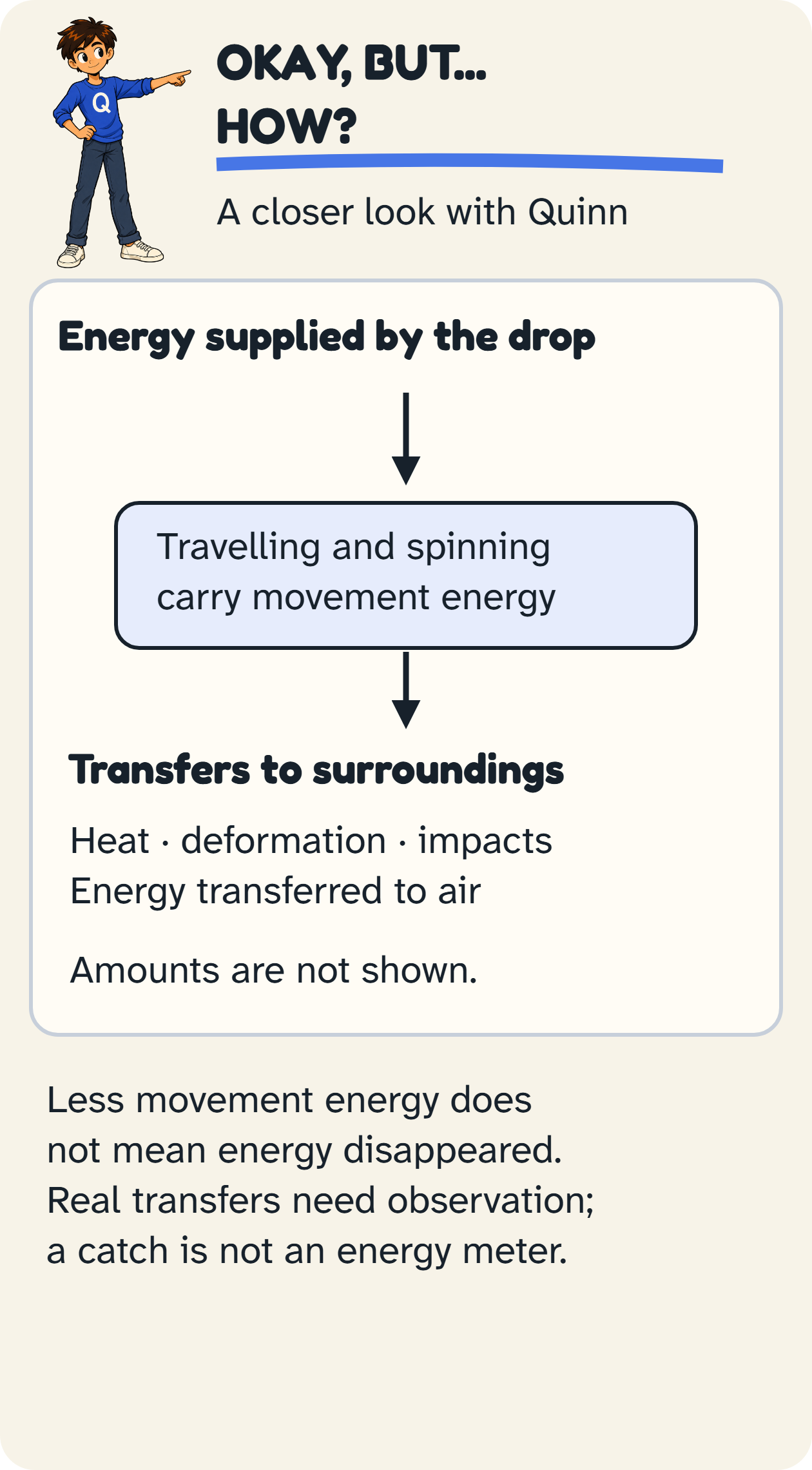
Diagram in words: Below Quinn’s branded header is a qualitative energy diagram. Energy supplied by the drop becomes travelling and spinning motion, with possible transfers to the track and surroundings through heat, deformation, impacts and air. No measured amounts are shown.
Open the full-resolution diagram
Try the idea
A designer adds cloth and the marble stays in the cup once. Does that prove how much energy became heat?
Answer: No. A catch is not a measurement of the energy transfers. Repeat the comparison and record the results; joints, release and cup geometry can also affect the outcome.
A little further, if you want
Optional: the ideal no-loss comparison deliberately sets these transfers aside. It helps isolate the effect of drop. A real setup needs its own observations before you can say how a change performs.
See it in action
No published Okay But story currently demonstrates this concept as a separate application.
From the story? Return to One More Take at this concept. Arrived directly? Browse Okay But stories. Normal browser Back returns you to your previous page.
Sources
- MIT: Potential Energy and Conservation of Energy — Endpoint height and energy transfers; sections14.2,14.4.1,14.8.
- OpenStax: Rolling Motion — Ideal rolling energy and real transfers.
- Exploratorium: Marble Machines Activity Guide — Practical slowing features, securing pieces and repeated tests; pages1–5.
Download this lesson with its diagram and answer (PDF)
Free classroom worksheets
Use this lesson in class or at home with separate student worksheets and a teacher answer key. All three PDFs are free to download, with no sign-up.
Chapters
Chapters are added when the episode is published.
Transcript
The speaker-identified transcript is published on this page with the episode. A written adaptation of the audio is a separate piece with its own sources — not a copy of this transcript.
Episode credits
- Presented by
- Bridget Zayner
- Published
- Series
- Okay, But…
- Transcript
- Human-checked before publication