Okay, But… Podcast episode
One More Take
native controls, keyboard operable, no autoplay
OKAY, BUT… HOW?
Quinn has a marble, a camera, and a desk that is running out of room.
The marble dropped into the cup, struck the rim, and hopped straight back out.
Quinn stopped recording.
On his phone, the run looked magnificent until the last half-second. A blue marble swept through a bend, rattled across a joint, and disappeared into a cup. Then it reappeared with other plans.
He wanted one clean shot: the whole journey, ending with the marble staying put. The phone had to stand far enough back to see the track. At present, it leaned against his pencil case, filming mostly pencil case.
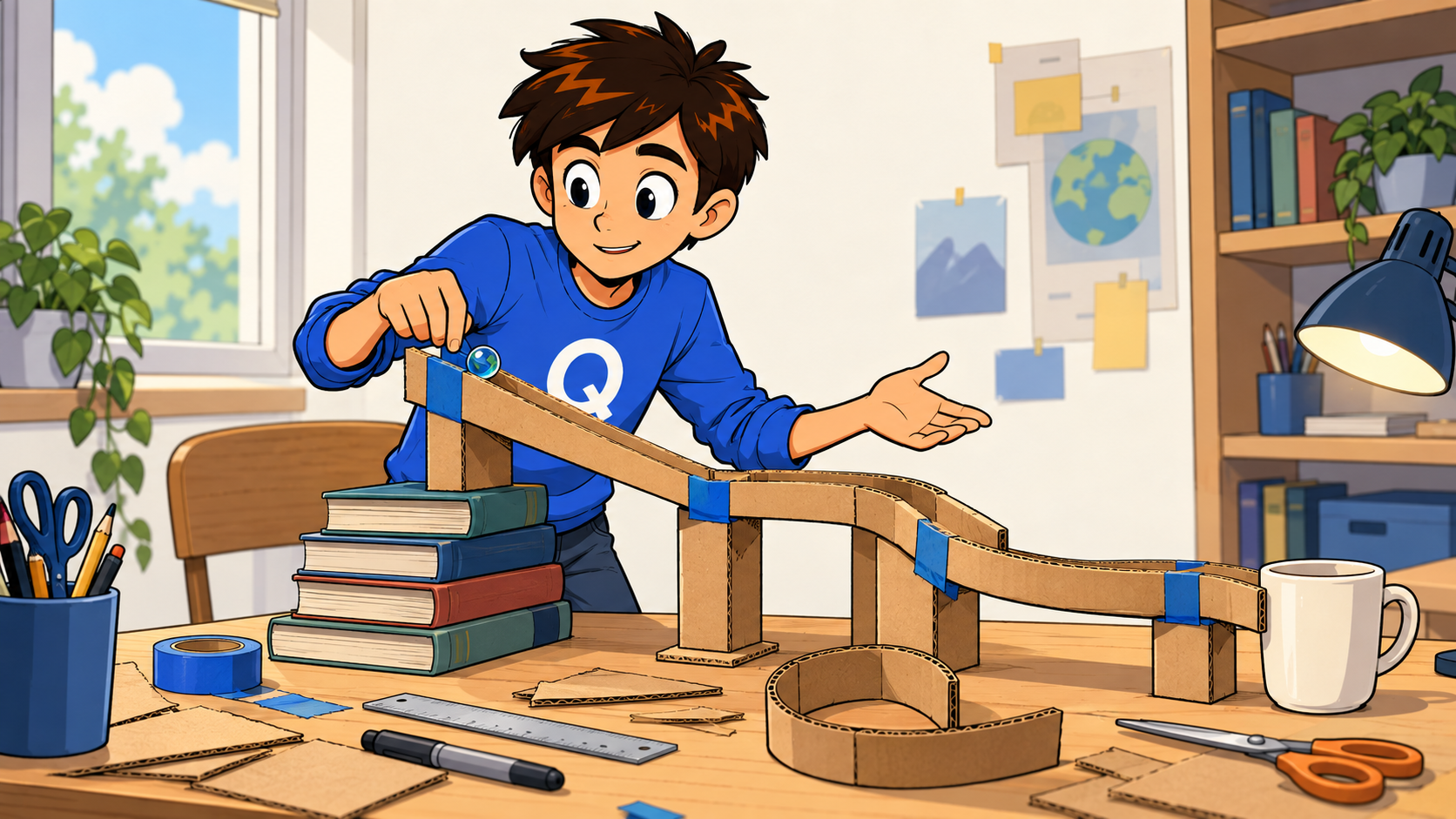
He could make the route longer. Give the marble a leisurely bend before the cup, let it use up its hurry. He had spare track, and the idea felt satisfyingly fixable.
He taped in a detour. Moved a book. Added another bend. Moved the book again. By the time the route was ready, the pencil case had nowhere to stand.
Quinn balanced the phone against a mug and released the marble from his usual mark.
It made the longer journey. It jumped out of the cup.
For a moment he kept watching the empty track, as if it might explain itself. The start was still beside the same stack of books. The cup was still on the desk. All that extra travelling had changed neither of those heights.
He reached for the marble, nudged the book stack, and caught it before the track came loose. The marble escaped his fingers farther down the track.
It rolled into the cup.
Quinn looked from the cup to his hand.
He put a small piece of tape where his fingers had been. Then he returned the marble to that lower point. Same track. Same cup. Less room between the marble and the desk.
He left it there for a moment, looking along the route.
Then he let go.
A rattle, a turn, a click against the cup. The marble stayed.
Quinn tried again. Another click. He moved back to the high mark: out it came.
Optional closer look: Fair, Repeated Trials
He had been trying to change how far the marble travelled. What seemed to matter here was how far it came down.
Optional closer look: Height into Motion
Quinn traced the slope with his finger. His track was a ramp: a sloping surface carrying the marble down. Holding the marble higher stores more energy in its position relative to Earth. As it descends, gravity can turn that stored energy into movement—the marble travelling and spinning.
Optional closer look: Rolling versus Sliding
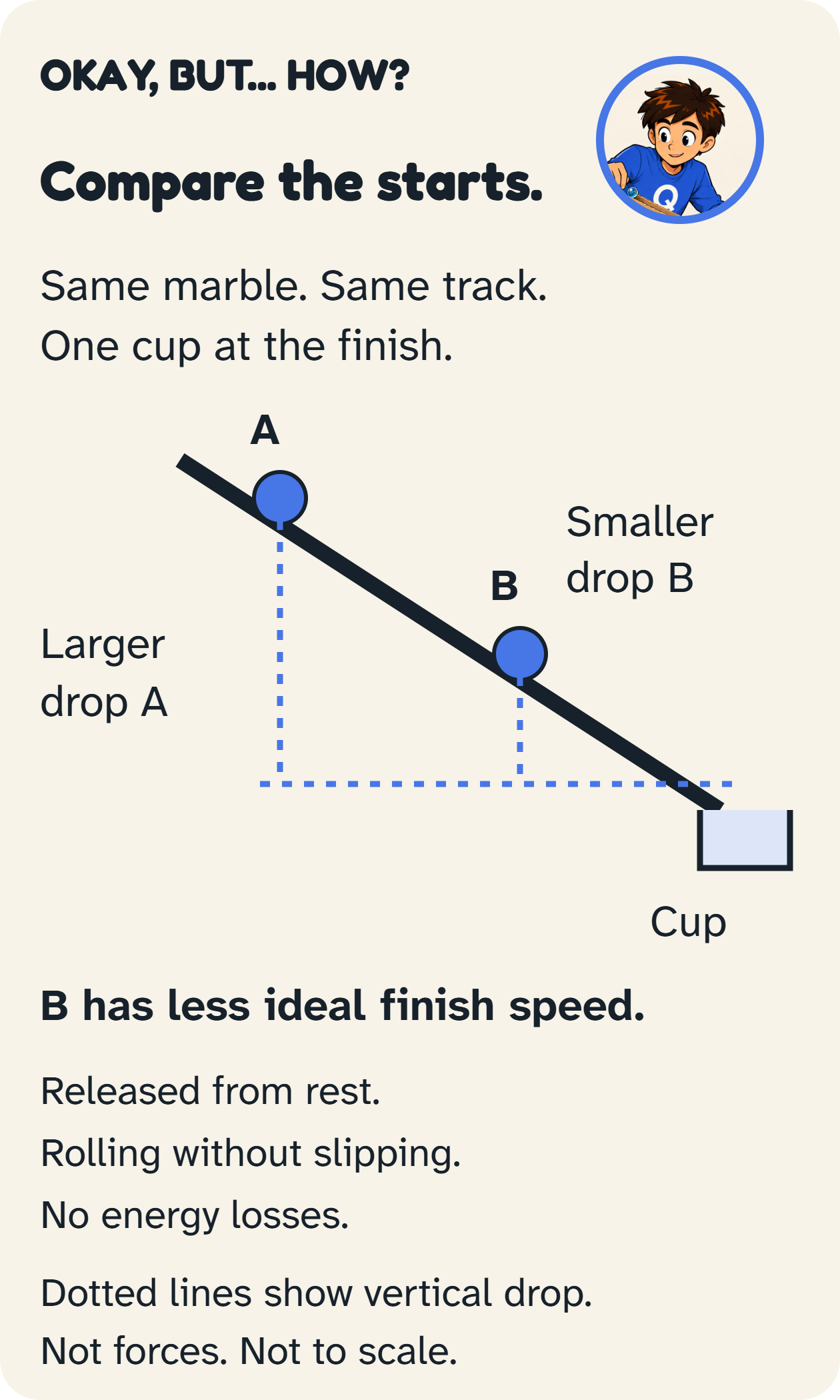
He pictured the same marble simply let go, not pushed, rolling down the ramp without skidding. In this ideal comparison, all the energy from the drop stays available for movement instead of some becoming heat or being transferred to the air. With those losses set aside, a smaller drop gives the same marble less speed at the finish. More track between the same heights is not, by itself, a brake.
Quinn’s joints and bends were real ones. The model gave him a useful comparison; the cup trials told him whether this particular arrangement worked.
Optional closer look: Where the Motion Energy Goes
He pulled out the detour. His book returned to the desk. His phone still could not see everything.
The cup occupied exactly the place where the camera needed to stand.
Quinn crouched beside the lower shelf. There was room for the cup there—and room on the desk for the phone. He guided the track down to it, keeping the entire route downhill.
He fetched the marble, then stopped at the old tape mark.
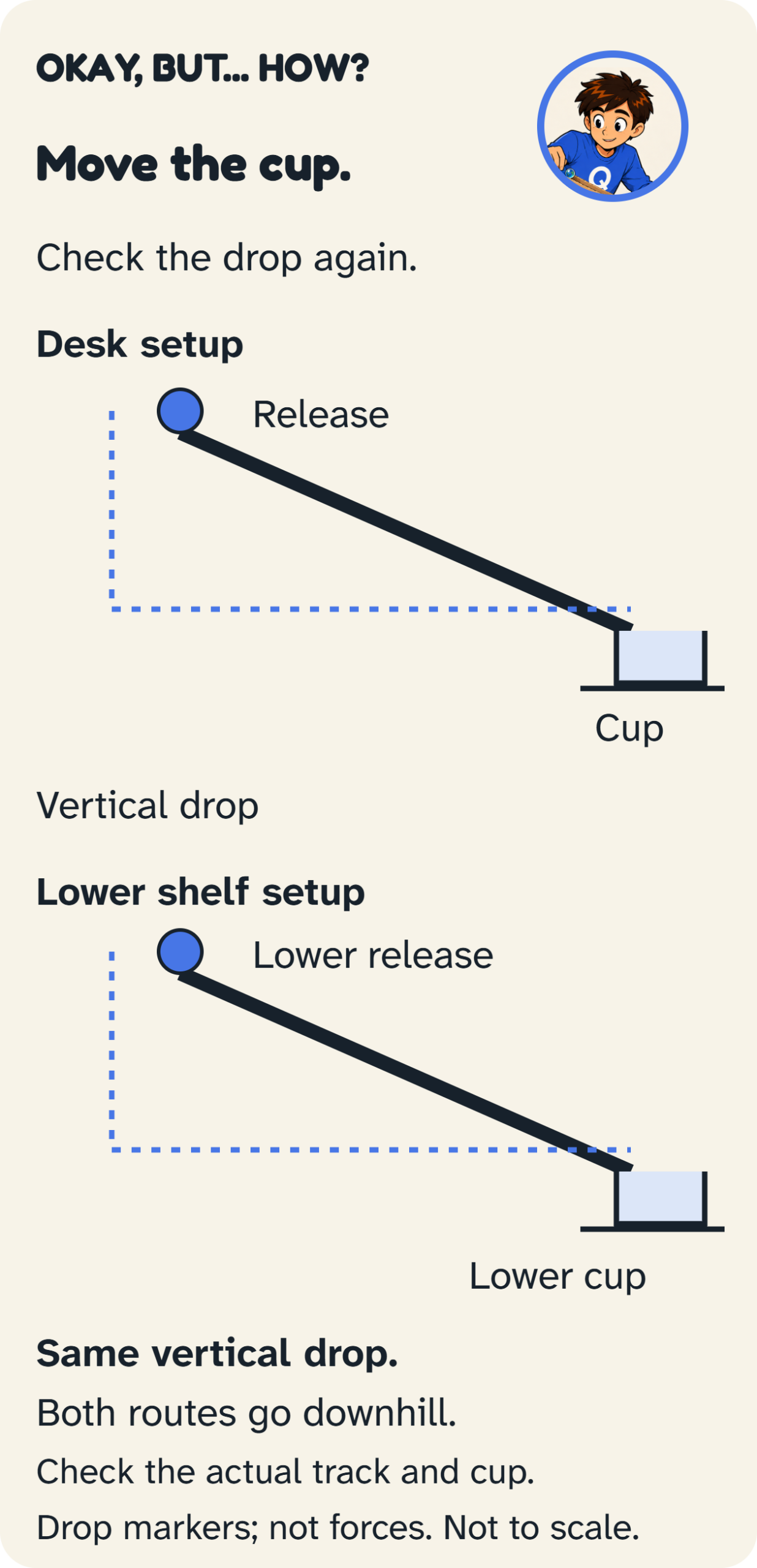
The cup was lower now. Leaving the start where it had been would give the marble a bigger drop. He had just found a gentle arrival; this was a peculiar way to keep it.
He lowered the release point too, until it stood the same vertical distance above the new cup as the successful desk setting had above the old one. The route was different, so he tested it before reaching for the phone.
Optional closer look: Vertical Drop versus Distance
The marble stayed in the cup. Again, it stayed.
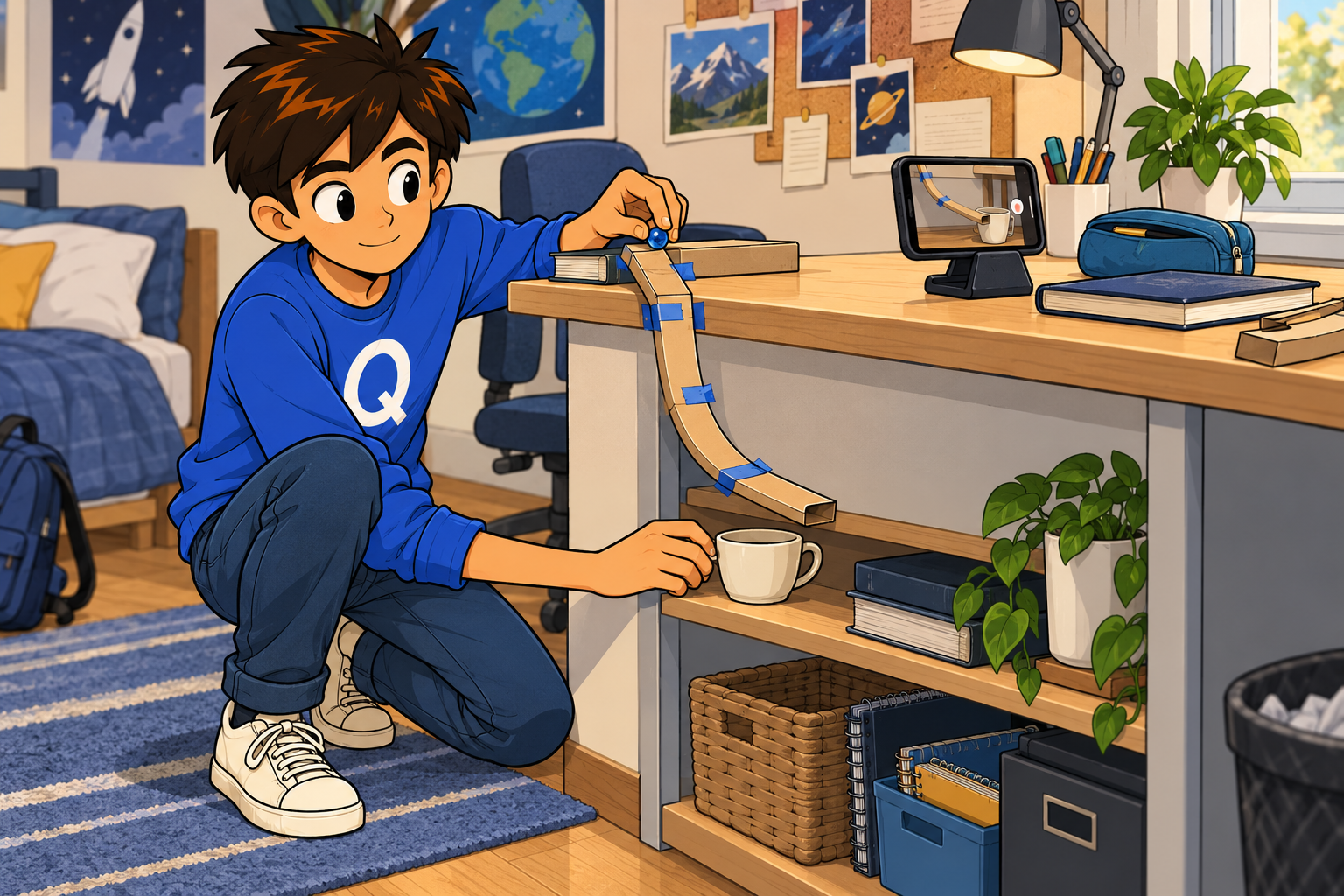
Now the phone could stand back. Quinn framed the books, the track, and the cup. He pressed Record.
The marble rolled through the shot and settled into its new destination.
He watched the clip all the way through before saving it.
There was one thing he could not tell just by looking. Had the new route taken longer, even with a similar drop? Quinn had his ending. His next film might need a timer.
Optional closer look: Finish Speed versus Arrival Time
The short version
Quinn compares the release point with the finish: a smaller vertical drop gives the same marble less ideal finish speed. Moving the cup means checking that drop again. A useful prediction still needs a trial on the actual track.
Optional: what the drop supplies
Height gives the marble–Earth system stored energy. As the marble rolls down, movement carries that energy in two forms: travelling and spinning. In the loss-free rolling comparison, the same marble and the same vertical drop give the same energy budget, even along different routes.
Slope affects gravity’s pull along a ramp and can change the journey. The energy comparison alone does not answer Quinn’s timing question. Real track losses also matter. The ideal comparison assumes release from rest, rolling without slipping, and no energy losses.
Sources
- OpenStax: Gravitational Potential Energy — Height change and energy from a vertical drop.
- OpenStax: Rolling Motion — Movement energy in travelling and spinning; the ideal rolling comparison.
- OpenStax: Inclined Planes — Gravity’s component along a slope.
Related evidence: MIT’s endpoint-energy explanation; MIT’s rolling-motion treatment; Exploratorium’s practical marble-run testing guidance. These support the model and design approach, not measured results for Quinn’s apparatus.
Free classroom worksheets
Use this story in class or at home with separate student worksheets and a teacher answer key. All three PDFs are free to download, with no sign-up.
Chapters
Chapters are added when the episode is published.
Transcript
The speaker-identified transcript is published on this page with the episode. A written adaptation of the audio is a separate piece with its own sources — not a copy of this transcript.
Episode credits
- Presented by
- Bridget Zayner
- Published
- Series
- Okay, But…
- Transcript
- Human-checked before publication