Okay, But… Podcast episode
Height into Motion
native controls, keyboard operable, no autoplay
OKAY, BUT… HOW? · A closer look
Question: What does a higher starting point give a marble?
You’ll be able to: Compare two release points and identify which supplies more energy from the drop.
A marble held above the finish has stored energy because of its position relative to Earth. Let it go without a shove: gravity can turn that stored energy into movement as it descends.
For the same marble near Earth, a bigger vertical drop supplies more gravitational energy. Measure straight down between the marble’s center at the start and its center at the finish. The winding route between them is a different measurement.
Quinn can move his release mark down the same ramp while keeping the finish in place. That reduces the drop. It gives him a useful energy comparison, but whether his particular cup holds the marble still needs an actual trial.
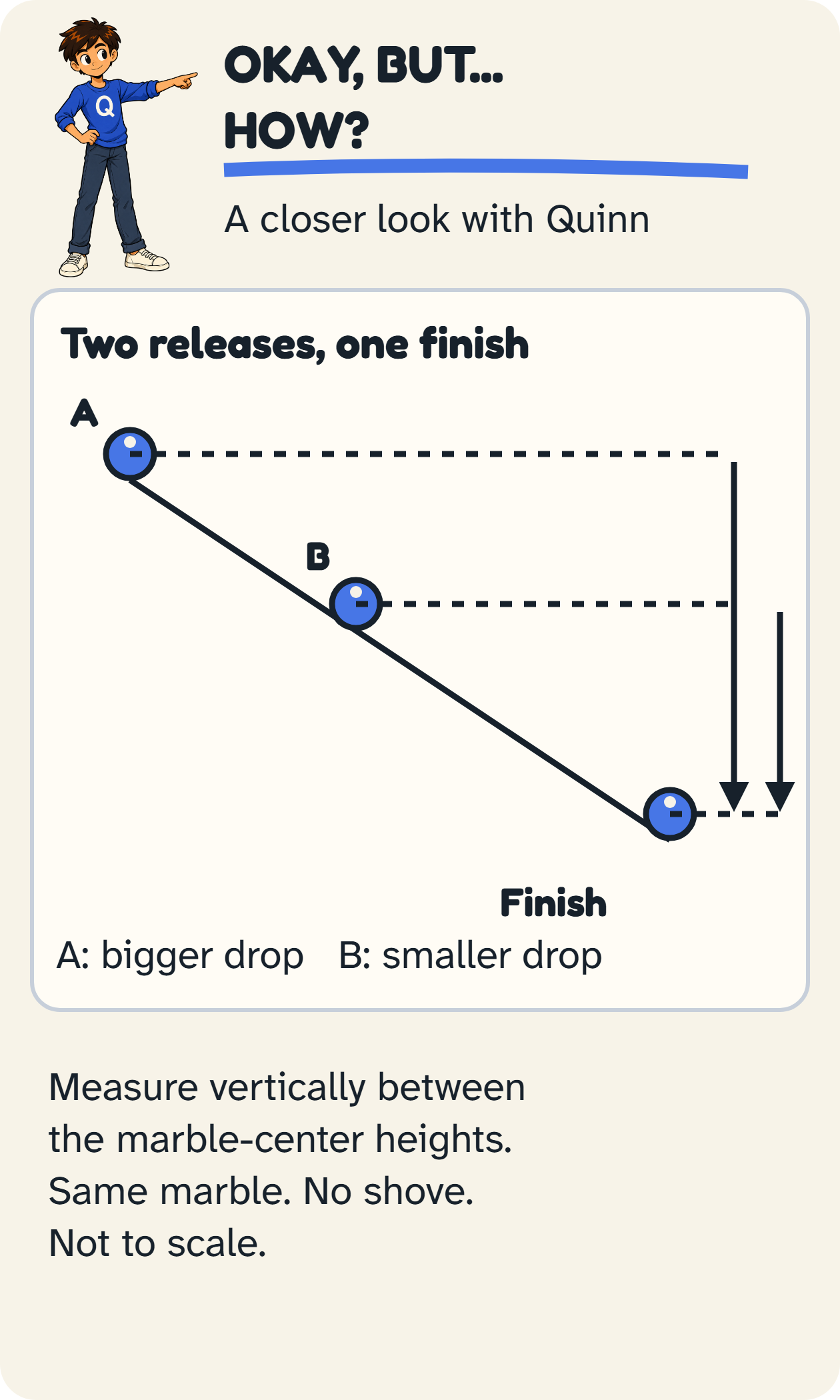
Diagram in words: Quinn points across the branded header above two release marks on one downhill ramp. Mark A is higher than B; both share a finish. Vertical arrows from the marble centers show a larger drop from A and a smaller drop from B.
Open the full-resolution diagram
Try the idea
Look at A and B. The marble and finish stay the same. Which release supplies more gravitational energy, and what measurement settles it?
Answer: A supplies more. Its marble-center height is farther above the finish. You need the vertical separation, not the number of bends or the length of track.
A little further, if you want
Optional: the stored energy belongs to the marble–Earth system. Choosing the finish as a reference makes the height comparison convenient; it does not mean energy vanishes at that height.
See it in action
One More Take — Quinn compares high and low release marks on the same track, then lowers the start when he moves the cup.
From the story? Return to One More Take at this concept. Arrived directly? Browse Okay But stories. Normal browser Back returns you to your previous page.
Sources
- MIT: Potential Energy and Conservation of Energy — Endpoint height and energy transfers; sections14.2,14.4.1,14.8.
- OpenStax: Gravitational Potential Energy — Height change and stored energy.
Download this lesson with its diagram and answer (PDF)
Free classroom worksheets
Take the height comparison into class with separate student worksheets and a teacher answer key. All three PDFs are free to download, with no sign-up.
Chapters
Chapters are added when the episode is published.
Transcript
The speaker-identified transcript is published on this page with the episode. A written adaptation of the audio is a separate piece with its own sources — not a copy of this transcript.
Episode credits
- Presented by
- Bridget Zayner
- Published
- Series
- Okay, But…
- Transcript
- Human-checked before publication