Okay, But… Podcast episode
Vertical Drop versus Distance
native controls, keyboard operable, no autoplay
OKAY, BUT… HOW? · A closer look
Question: Does a longer route mean a slower finish?
You’ll be able to: Distinguish route length from vertical drop and state the conditions for an ideal finish-speed comparison.
A detour adds travelling. It does not necessarily reduce the energy supplied by gravity. That depends on the change in height between the start and finish.
Imagine the same marble on two downhill routes with equal vertical drops. Release it without a push. Let it roll without skidding, with no energy transferred away through track losses or air resistance. In that ideal comparison, both routes give the same finish speed. The longer route is not an extra brake.
Real tracks have joints, changing surfaces and losses. An extra bend can change those conditions, so equal drop is not a promise of equal real-world results—or a successful catch. Quinn uses the comparison to choose a layout, then tests that layout.
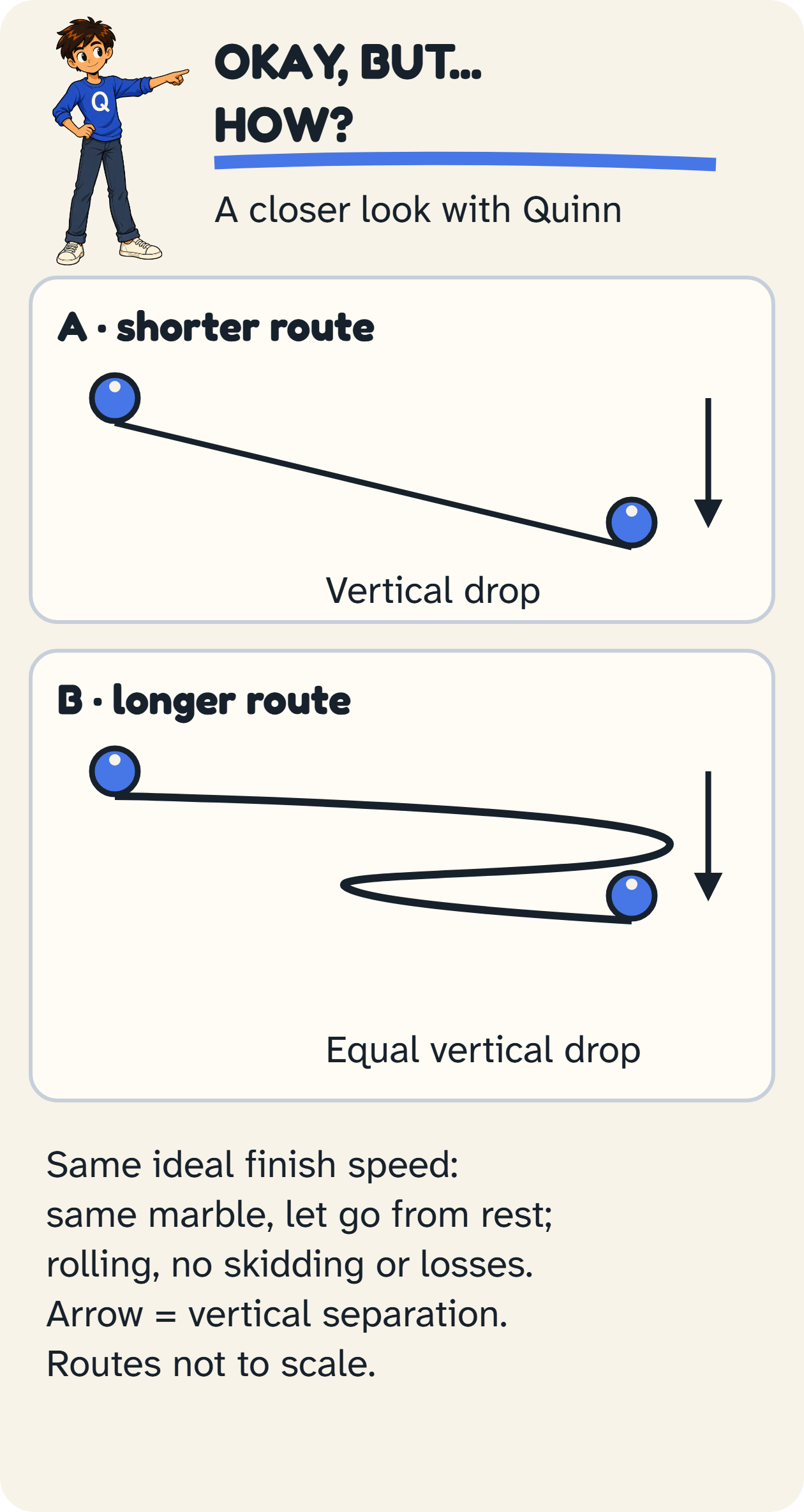
Diagram in words: Two stacked downhill route panels have starts and finishes at matching relative heights. Route A is shorter and route B is longer. Equal vertical drop arrows are separate from each drawn route. The ideal conditions are written below.
Open the full-resolution diagram
Try the idea
Someone says, “I added more track, so the marble must finish slower.” What has the person not checked?
Answer: The start-to-finish drop and the real losses. In the stated ideal rolling comparison, extra distance alone does not lower finish speed. A real detour might change losses, which needs testing.
A little further, if you want
Optional: a rolling marble carries movement energy in travelling and spinning. Keeping the same marble keeps that relationship fixed. Changing its shape or adding a powered push changes the comparison.
See it in action
One More Take — Quinn removes an unhelpful detour and preserves the drop while moving the finish to a lower shelf.
From the story? Return to One More Take at this concept. Arrived directly? Browse Okay But stories. Normal browser Back returns you to your previous page.
Sources
- MIT: Potential Energy and Conservation of Energy — Endpoint height and energy transfers; sections14.2,14.4.1,14.8.
- MIT: Rigid Body Dynamics — Rolling, spin and contact; examples21.4–21.5.
- OpenStax: Rolling Motion — Ideal rolling energy and real transfers.
Download this lesson with its diagram and answer (PDF)
Free classroom worksheets
Explore vertical drop and track distance with separate student worksheets and a teacher answer key. All three PDFs are free to download, with no sign-up.
Chapters
Chapters are added when the episode is published.
Transcript
The speaker-identified transcript is published on this page with the episode. A written adaptation of the audio is a separate piece with its own sources — not a copy of this transcript.
Episode credits
- Presented by
- Bridget Zayner
- Published
- Series
- Okay, But…
- Transcript
- Human-checked before publication