Okay, But… Podcast episode
Rolling versus Sliding
native controls, keyboard operable, no autoplay
OKAY, BUT… HOW? · A closer look
Question: What is a rolling marble doing besides moving forward?
You’ll be able to: Identify travelling and spinning, and explain why rolling is not interchangeable with sliding.
Watch a dot on a rolling marble. Its center travels along the track while the dot turns around that center. These are two parts of its movement: travelling and spinning.
A block can slide along a surface without turning. A ball can also skid while it spins. “It is spinning” alone does not prove that it is rolling without slipping.
For ideal rolling on a stationary rigid track, the contact does not slide across the surface. Friction there can help the ball turn without draining movement energy through sliding. Real deformation and skidding are different conditions. Treating all friction as the same energy loss would miss that distinction.
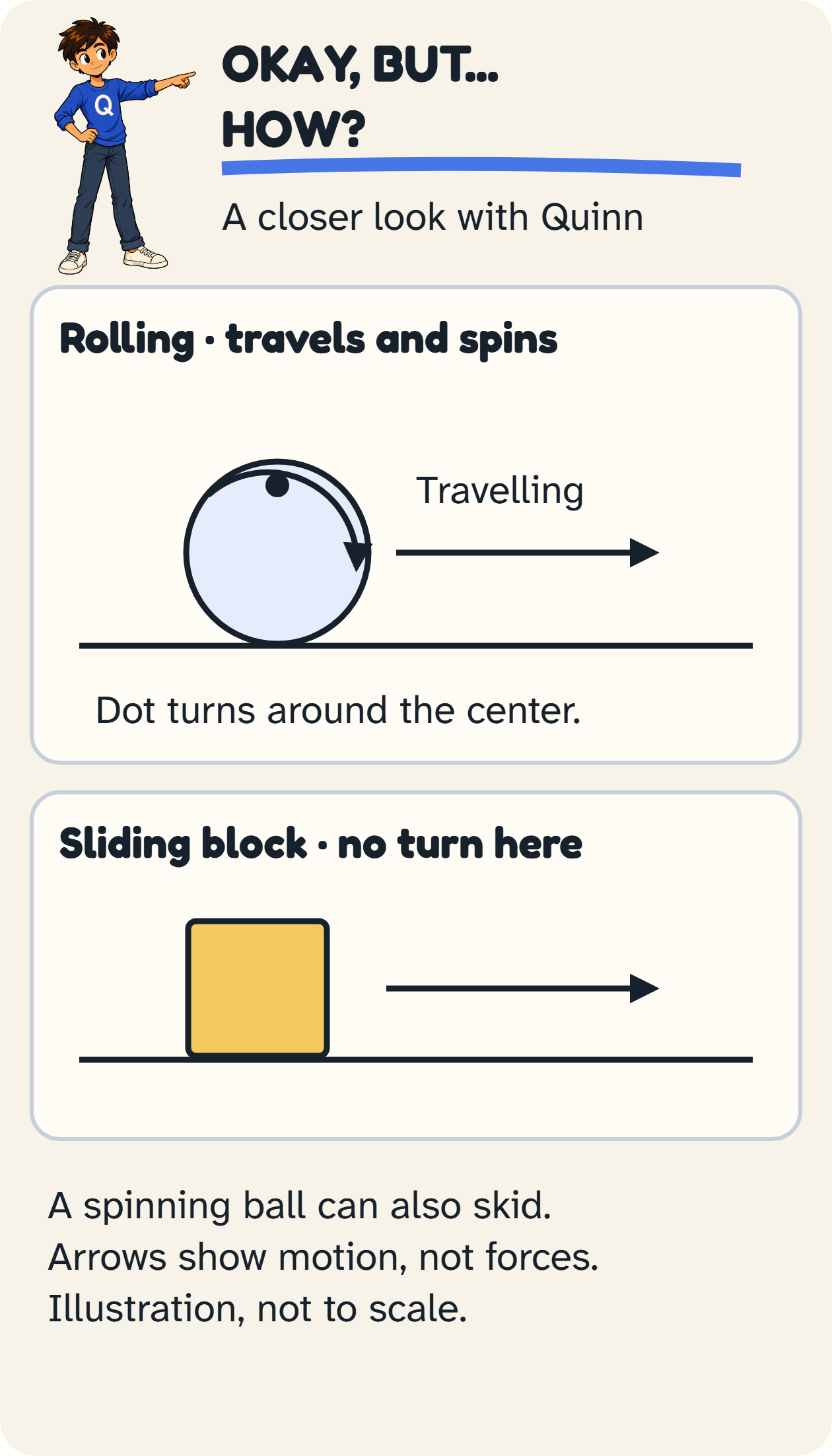
Diagram in words: Below Quinn’s branded header, a rolling ball with a forward center arrow and a curved spin arrow around a marked dot. A separate sliding-block panel has a forward arrow and no rotation. A note says a spinning ball can also skid.
Open the full-resolution diagram
Try the idea
A dot circles around a ball’s center while the ball moves forward. Have you shown that the ball is not skidding?
Answer: No. You have shown spinning and travelling. To establish rolling without slipping, the contact must not slide against the track. A spinning ball can still skid.
A little further, if you want
Optional: both travelling and spinning carry movement energy. How it is shared depends on the object’s shape and mass distribution; a cylinder’s formula is not automatically a marble’s formula.
See it in action
No published Okay But story currently demonstrates this concept as a separate application.
From the story? Return to One More Take at this concept. Arrived directly? Browse Okay But stories. Normal browser Back returns you to your previous page.
Sources
- MIT: Rigid Body Dynamics — Rolling, spin and contact; examples21.4–21.5.
- OpenStax: Rolling Motion — Ideal rolling energy and real transfers.
Download this lesson with its diagram and answer (PDF)
Free classroom worksheets
Explore travelling, spinning and contact with separate student worksheets and a teacher answer key. All three PDFs are free to download, with no sign-up.
Chapters
Chapters are added when the episode is published.
Transcript
The speaker-identified transcript is published on this page with the episode. A written adaptation of the audio is a separate piece with its own sources — not a copy of this transcript.
Episode credits
- Presented by
- Bridget Zayner
- Published
- Series
- Okay, But…
- Transcript
- Human-checked before publication