Okay, But… Podcast episode
The Long Way Up
native controls, keyboard operable, no autoplay
Why is it easier to push something up a ramp than to lift it straight up, and what’s the catch?
My grandfather was coming to stay with us for a few weeks after hip surgery, and he’d be using a wheelchair. Our front door has three steps, 18 inches from the walkway to the porch. My job was to work out a route for a ramp and help build it before he arrived.
I figured a ramp was a plank. It turned out to be quite a bit more interesting than that.
Straight up
First I wanted to know what a ramp was saving us from. Lifting a chair and person means supporting their full combined weight. Sharing that weight between two people doesn’t make it disappear. We weren’t going to test that with Grandpa.
I made a small stand-in: a box of books secured to my old skateboard. Mom had a luggage scale she used to check suitcases before flights. I hooked it to the front to measure my pull, keeping it in line with the board to measure along the slope. My uncle steadied the boards and held a safety cord attached to the skateboard so it couldn’t roll away. We kept clear of its downhill path.
The first plank
There was a 4-foot plank in the garage. We supported it from the walkway to the top step. I pulled the skateboard up slowly, with the scale pointing along the plank.
Same box, same height. Would a longer board take more pull because the trip was longer, or less because the climb was gentler?
On a level board, the books could rest there without me holding them up. The board took their weight. Tilt it and gravity could pull them toward the low end. The steeper the board, the more directly my uphill pull opposed gravity. A gentler board carried more of the support, leaving less for me to pull against along the slope. The books weighed the same throughout; resistance from the wheels and boards added to my pull.
A steep plank left a bigger downhill pull. Letting go wasn’t a useful way to test that.
Longer and longer
Our neighbor had boards left over from an old fence. We tried a 6-foot one and a 10-foot one, keeping the same top step. The scale readings wandered, but the sustained pull was lower on the longer boards. I could feel the difference too. The extra distance was buying me something.
Optional: why might scale readings wander?
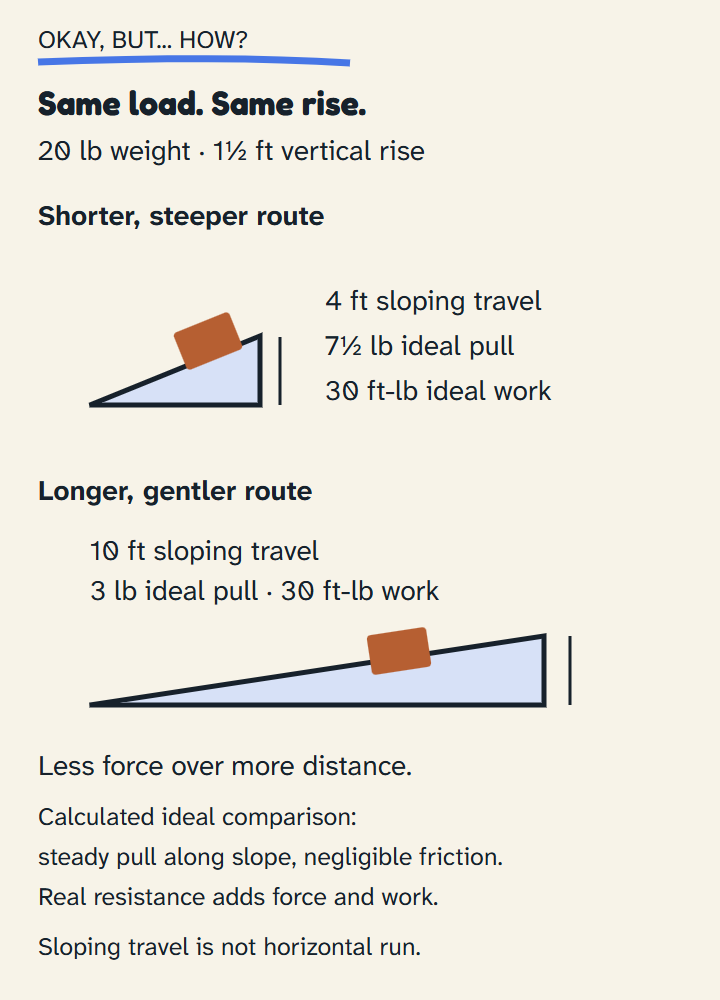
To separate the slope from the rough boards and wheels, I worked out an ideal calculated comparison, not a table of scale readings. Suppose the load weighed 20 pounds and rose 1½ feet. Ignore friction and pull steadily along each slope.
For the 4-foot plank, the 1½-foot rise was 1½ ÷ 4 of the sloping trip. That same fraction of the 20-pound weight pulled downhill: 20 × 1½ ÷ 4 = 7½ pounds. Making the trip longer without raising the top reduced that fraction. I worked out the other lengths the same way.
| Route | Calculated ideal pull | Distance along the route |
|---|---|---|
| Straight up | 20 lb | 1½ ft |
| 4 ft plank | 7½ lb | 4 ft |
| 6 ft board | 5 lb | 6 ft |
| 10 ft board | 3 lb | 10 ft |
Here, pounds means pounds of force. The longer the ramp at the same height, the gentler the slope, and the smaller gravity’s pull along it.
Our scale couldn’t turn rough boards into that ideal model. Starting and moving readings differed, and wheel resistance added to the pull. The calculation explained the trade; it didn’t supply our actual readings.
On the longest board, the trip was almost seven times the vertical lift. I multiplied each calculated pull by its distance. Every row gave 30 foot-pounds of work: force acting through distance in its direction.
That was the trade an inclined plane made possible. The ramp hadn’t removed the work of gaining height. It had spread it out. A smaller ideal pull over a longer distance did the same work. Real resistance added more. But needing less force at once could make a load manageable when lifting it straight up was beyond me. Equal ideal work didn’t mean equal ease or tiredness.
Optional: if work stays the same, why does a ramp help?
How gentle is gentle enough?
I looked up the U.S. Access Board’s ADA guidance. Its usual maximum ramp slope is 1 inch of rise for every 12 inches of horizontal run. That was a design benchmark, not a ruling on our private house or a guarantee Grandpa could use it alone.
For our 18 inches, that meant 18 feet of horizontal run—a little farther along the slope, before landings. Wheels, surfaces and Grandpa’s needs still mattered. A gentle grade wouldn’t control the chair’s descent for him.
The catch
Then I measured our front walkway. From the bottom step to the sidewalk was 12 feet.
A gentle push costs distance, and distance costs space. A straight route that long wouldn’t fit.
Folding the distance
On the drive up to the lake that weekend, I watched the road zigzag up the hill, the way it always does. This time I counted the turns. Seven.
The turns gave the road a longer climbing route than a straight climb. That gave me an idea for our ramp, not a ready-made design.
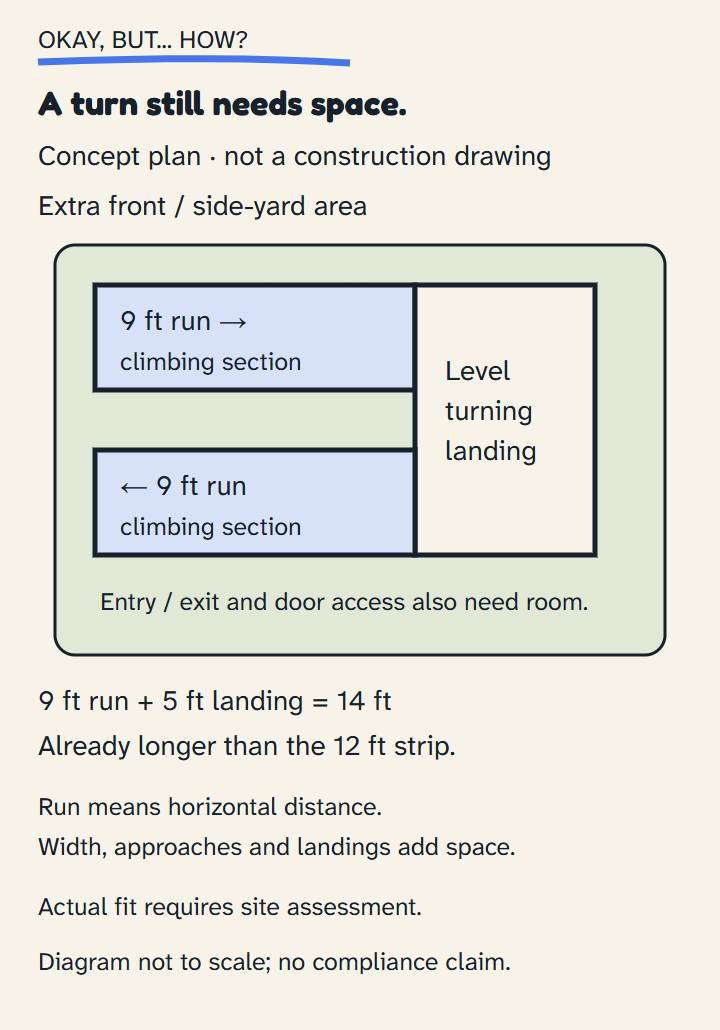
Instead of running straight out from the steps, could it run along the house and turn back?
Two 9-foot horizontal runs could share the climb, with a level landing between them. But a 5-foot turning landing would already make that direction 14 feet, before the approaches. It still wouldn’t fit our 12-foot strip.
I measured the wider front and side yard with my uncle. There was more room there. We marked the obstacles and took the measurements to an experienced ramp installer, who checked that a suitable layout, including landings and door access, would fit.
Building it
Here’s what went into the final ramp:
- Route: two climbing sections using the additional yard space, with their rise and horizontal run checked together.
- Landings: level space to rest and turn, including at the door. Those spaces needed room of their own.
- Frame and deck: my uncle and the installer handled the structure and checked the site requirements. I helped with measuring and assembly under their direction.
- Surface: firm, stable and slip-resistant. Strips alone couldn’t guarantee traction in rain, so wet conditions still mattered.
- Edges and rails: protection and handholds included in the checked layout.
Grandpa and his discharge team had agreed how he would use his chair and what help he needed. The first time he tried the ramp, he chose to push himself, with an adult nearby as arranged. He paused on the landing, turned, and kept going to the porch.

Ramps everywhere
After that, I kept seeing them: the slope into school, the loading dock behind the grocery store, the curb cut at the crosswalk, the moving truck’s ramp down the street.
I started looking for the extra distance and the space it used. Slope mattered, but so did the load, surface, available room and person using the route.
We hadn’t made our steps shorter. We’d found room for a longer way up.
One more thing
While I was helping with the last screws, I looked at one closely. The thread winds around and around the shaft, climbing a little with every turn.
It’s a ramp too, wrapped around a post. What changed when you turned it? That was my next question.
Follow that question: how is a screw a ramp?
The short version
Lifting straight up means supporting the whole weight. A ramp supports the load across its surface, reducing the ideal force needed along the slope. Less force costs more distance. Turning the route can help use a wider space, but landings and approaches need room too.
Optional: how much less force?
For a steady pull parallel to a ramp with negligible friction, ideal pull equals weight × vertical rise ÷ sloping length. Double that length at the same rise and weight: half the pull, twice the travel. Real resistance adds work; its size needs checking.
The calculated 20-pound example gives 30 foot-pounds for every route. That is ideal model work, not a measured result from the skateboard.
Sources
- OpenStax: Inclined Planes — gravity’s pull along a slope.
- OpenStax: Simple Machines — the ideal force-distance trade.
- U.S. Access Board: Ramps and Curb Ramps — slope, landings, edges and handrails.
- NASA Glenn: The Screw — a screw as an inclined plane wrapped around a shaft.
Associated learning materials
- The Long Way Up: student concept test — six questions about force, distance and using ramps.
- Educator answer guidance — explanations, acceptable alternatives and misconception cues on a separate page.
Chapters
Chapters are added when the episode is published.
Transcript
The speaker-identified transcript is published on this page with the episode. A written adaptation of the audio is a separate piece with its own sources — not a copy of this transcript.
Episode credits
- Presented by
- Bridget Zayner
- Published
- Series
- Okay, But…
- Transcript
- Human-checked before publication