Tales That Shaped Us Podcast episode
Amaterasu and the Rock Cave
When Japan’s sun kami retreats into a rock cave, the world falls dark. Enter a vivid retelling of Amaterasu’s story, with illustrations and learning activities exploring curiosity, laughter and collective help.
native controls, keyboard operable, no autoplay
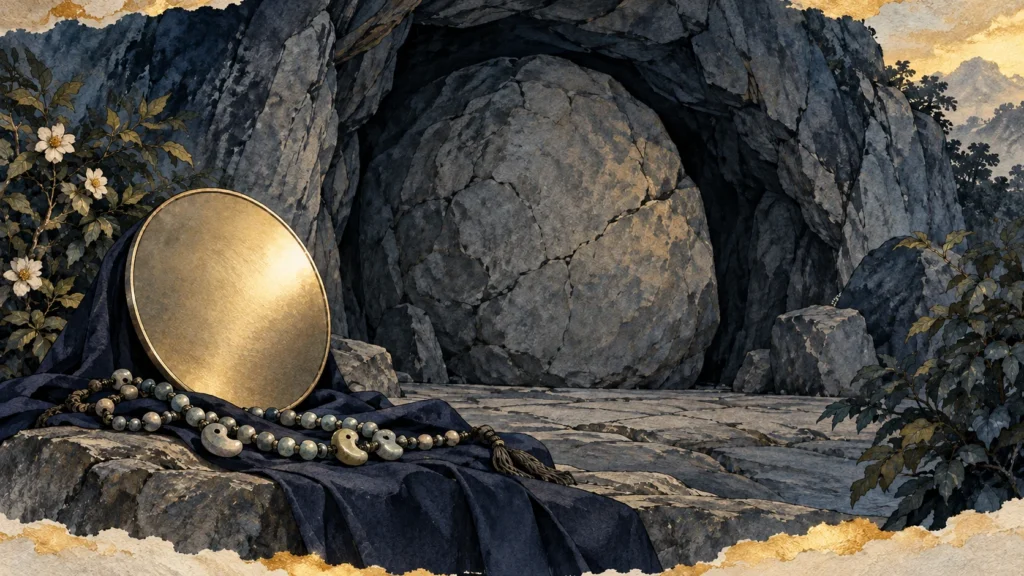
Tales That Shaped Us · Japan · Episode 002
Amaterasu and the Rock Cave
When the sun retreats, a gathering answers with craft, curiosity, and laughter.
Before we enter the cave
This Japanese myth follows Amaterasu, the sun kami, after her brother’s violence frightens her into a rock cave. With light gone from their world, the other kami gather their different abilities—and a startling performance—to draw her out.
You do not need to know Japanese mythology to begin. The Chronicler introduces the characters as they enter the tale. Read straight through, then choose a question, a source, or a learning activity if you want to linger.
Content note: the tale includes destructive behavior, a death described without graphic detail, and a performer’s bold exposure described without anatomy. You may skip an activity or discuss a fictional situation instead of your own experiences.
Come a little closer. We are going somewhere the light can leave of its own accord.
Most of us make plans on the assumption that morning will arrive. Very few calendars leave space for “check that daylight still works.” In this tale from Japan, however, light depends on a presence who can be frightened, offended, and driven away.
Her name is Amaterasu. She is the sun kami and ruler of the heavenly plain. Kami is the tradition’s word for sacred beings or presences; here we will meet them as characters, each with a part to play in the world. Amaterasu’s light reaches both their heavenly world and the land below.
Her brother, Susanoo, is a kami associated with wind and rain and entrusted with rule over the sea. He has come into his sister’s heavenly world. There, what he calls a victory will become something Amaterasu can no longer excuse.
When she shuts herself inside a rock cave, the others must find a way to bring her out. They have strength, ingenuity, and craftspeople who can make a mirror. They also have a performer willing to astonish a gathering that has almost forgotten how to laugh.
The question waiting here is unsettling: if something your whole world depends on withdraws, how do you reach it again? This tale gives that question a voice, a body, and a closed door. Its answer will be considerably livelier than a solemn appeal.
This is a TTSU reimagining of the Kojiki cave story, using the reviewed account of Chamberlain’s 1882 translation. Dialogue, inner thoughts, atmosphere, and connective action are authored storytelling, not translation or recovered ancient words.
The story
When Susanoo came to heaven, Amaterasu suspected he meant to challenge her rule.
“Have you come to take what is mine?” she asked.
They put his intentions to a trial: a pledge contest intended to test the purpose of his visit. Amaterasu wanted to know whether the brother before her was a threat to her heavenly world.
Susanoo claimed the outcome vindicated him.
“I have won,” he declared.
Then his triumph spread into places where others had work to do.
There were rice fields under Amaterasu’s care. Banks divided them, and irrigation channels carried the water the growing rice needed. Susanoo tore through those divisions and filled the channels. The careful arrangement of earth and water broke apart under his hands.
Amaterasu looked at the damage and found an explanation that might spare her brother blame.
“Perhaps he thought the ground could be put to better use,” she said.
Then he fouled the hall where the first fruits of the harvest were offered. Even there, she tried to excuse him.
“Perhaps he did not mean it.”
The excuses gave her something to say. They did nothing to stop him.
Inside the weaving hall, garments were being made for sacred use. Threads stretched at the looms; the weavers attended to their work. Amaterasu was there with them when the roof broke open.
Susanoo dropped the body of a horse into the hall.
The work stopped in terror. The attack brought fatal injury at a loom, and death entered the place where the garments were being woven.
Amaterasu recoiled. The broken roof, the interrupted work, the death at the loom: she could no longer make any of it safe by finding an excuse for her brother.
Fear drove her from the hall. She fled to the heavenly rock cave, seeking stone between herself and what she had witnessed.
She went inside and closed the rock door. Her heavenly world lay on the other side.
Darkness covered the heavenly plain. Below it, the Central Land of Reed Plains—the name this account gives the world beneath—became dark as well.
The kami called to one another. Shapes they had known at a glance disappeared into the blackness. They gathered by voices, close enough to hear the next speaker.
Amaterasu’s absence reached them all. Somewhere beyond the stone she was still present, but her light no longer filled their world.
They needed a plan.
Among them was Omoikane, the kami they turned to when something required thought. They asked him to devise a way to bring her out.
He considered the cave entrance, the closed door, and those gathered before it.
“We need her to open it,” he said.
That was the difficulty. They could assemble all the power outside the cave and still have Amaterasu refusing them from within.
Omoikane set their different abilities to work.
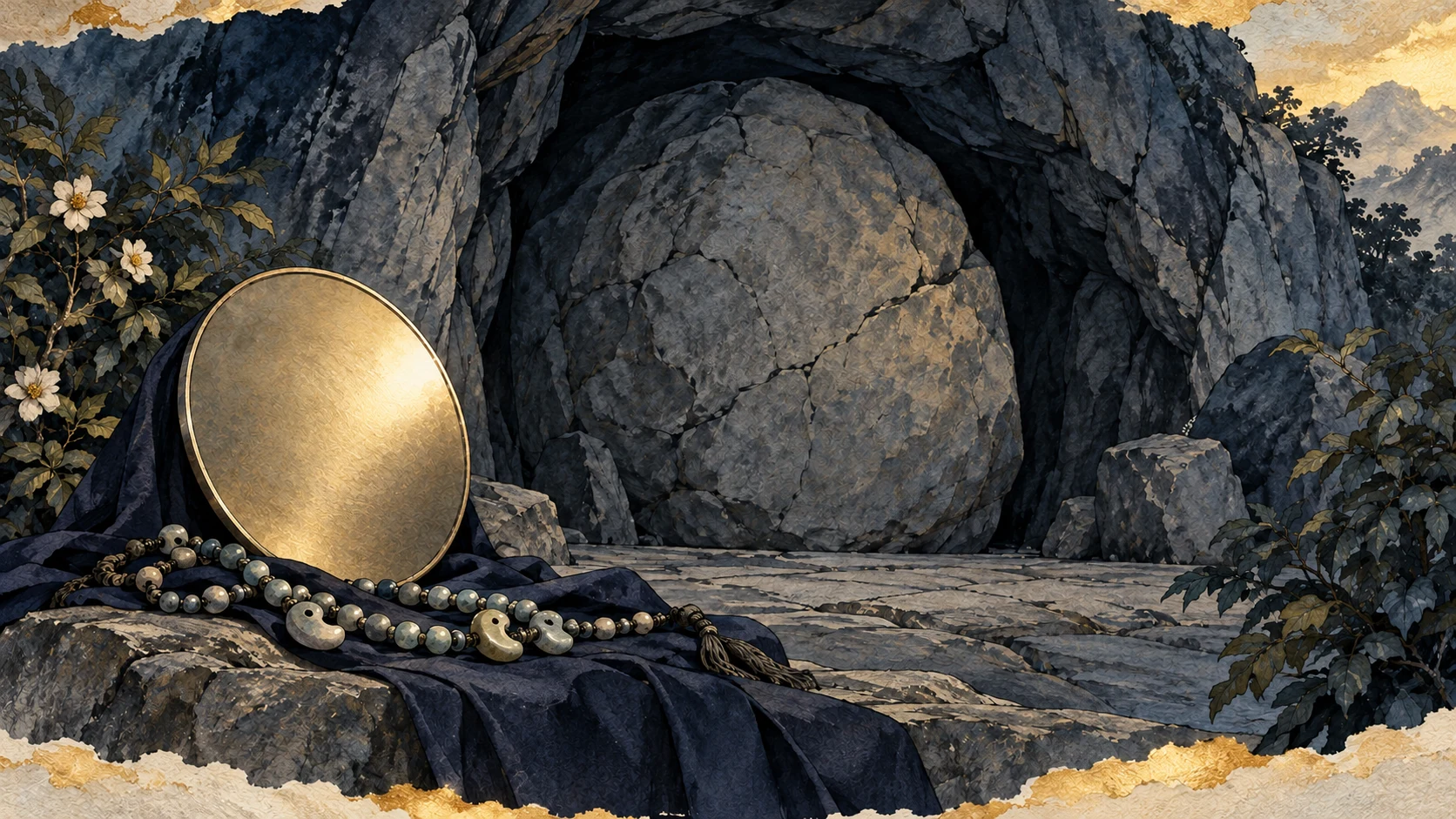
Craftspeople made a mirror and strings of beads. The mirror would show a face to anyone looking into it; the beads joined the preparations before the cave. The kami conducting the ceremony arranged offerings—the gifts they would formally present before the cave. Work passed from hand to hand, and the gathering began to take shape around a purpose.
Among those conducting the ceremony was Futotama, a kami helping arrange its offerings. He also helped prepare the mirror to be presented at the entrance. When Amaterasu looked out, he would be there to help show it to her.
Tajikarao, a kami whose strength lay in his powerful hands, took his place beside the rock door. He could reach someone coming through the opening. Until there was an opening, he waited.
Then came Ame-no-Uzume, the female kami who would rouse the gathering with her dance before the cave.
She put on leafy adornments and took foliage in her hands. Before the entrance was a wooden surface that could sound beneath her feet. She stepped onto it.
Her foot struck the wood.
The sound carried toward the stone.
She stamped again. Another beat answered the first. The gathered kami heard the rhythm grow louder.
Uzume shook the foliage in her hands. Her movements grew wild and uninhibited; she performed as though a force had taken hold of her. There was no careful dignity in the way she offered herself to the gathering now. She let her clothing fall open in a bold display, abandoning the decorum they might have expected.
The sound of her performance filled the gathering, and laughter broke out among the kami.
Uzume stamped harder. The wooden surface answered; laughter answered laughter. Merriment spread through the assembly until the heavenly plain rang with it.
Inside the cave, Amaterasu heard the sound.
She had left them in darkness. She knew what her withdrawal meant for heaven and the land below. Yet beyond the door there was stamping, and beyond the stamping there was laughter.
She listened.
It was not a plea. It was not someone calling her name. The gathering sounded as though it had something to rejoice in.
Amaterasu came closer to the rock door.
The noise went on.
She moved the door just enough to make a narrow opening and looked out.
“I have withdrawn,” she said. “Heaven and the land below are dark. Why are you laughing?”
Uzume turned toward her. She had brought the sound through the stone; now she could speak to Amaterasu herself.
“Because we have someone here more splendid than you.”
Amaterasu stayed at the narrow opening.
Someone more splendid? Who had come while she was shut inside?
Futotama and another participant brought the mirror forward, presenting it as the answer to Uzume’s claim.
A presence faced Amaterasu within it.
She moved nearer to investigate the figure they were showing her. The image moved as she did, but the narrow doorway limited what she could examine. Astonishment drew her farther out; she wanted to see this supposed other presence for herself.
She leaned toward the mirror.
Outside, Tajikarao had been waiting beside the entrance. The others had called upon his strength, but it was this moment he needed: Amaterasu within reach.
He took her hand and pulled her out.
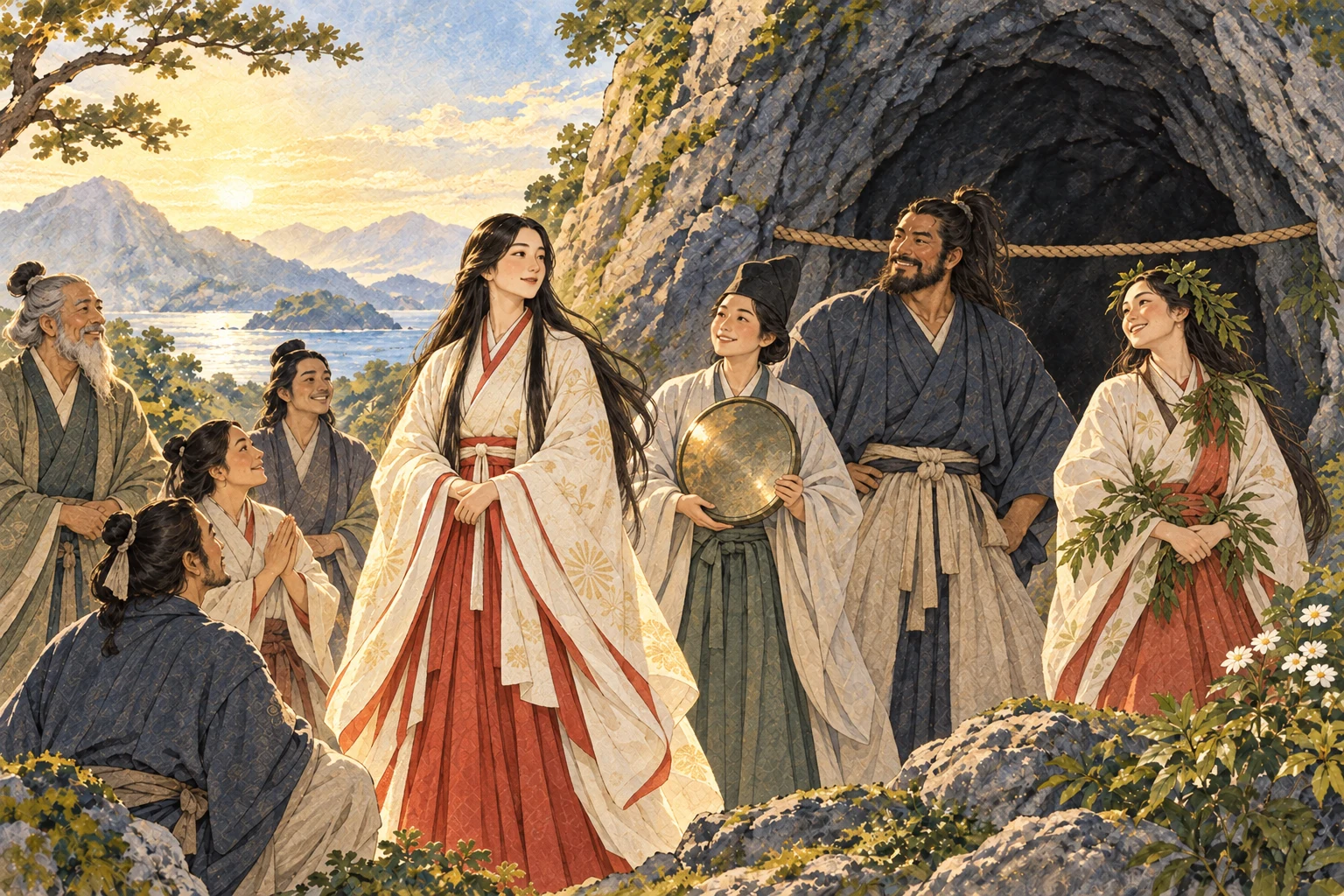
Suddenly she stood among the kami, with the mirror before her and the cave behind her.
Futotama stretched a rope across the way back. Its placement marked a boundary at the entrance.
“You must not go farther back than this,” he told her.
The opening from which Amaterasu had looked was now behind the rope. Around her stood the gathered kami: the thinkers and makers, the offering participants, the performer, the one who had waited to reach her.
The heavenly plain became light.
Below it, the Central Land of Reed Plains became light too.
The faces that had been voices in the darkness could see one another again. The mirror shone before Amaterasu. Uzume’s stamping had ceased, and the wooden surface lay quiet beneath her feet.
Amaterasu was outside the cave.
Light had returned to their shared world.
The Chronicler returns
There is an extraordinary change of sound in this story: first the breaking of a roof, then stamping and laughter heard through stone. One drives Amaterasu away. The other catches her attention in the place where she has withdrawn.
Her departure has a cause. She has tried to excuse her brother until his violence brings death among the weavers. The darkness follows a frightened withdrawal; the returning light does not undo what drove her inside.
The laughter gives me a point of recognition. I know that small tug when a gathering sounds delighted and no one has told me why: what am I missing? It is a modern thought I bring to the telling, alongside the much larger fear and surprise Amaterasu carries.
I also find an opening here through fear and isolation. The laughter reaches her where another demand might have left her behind the door. It does not repair the harm or bring her out by itself. The craftspeople’s work, the mirror, and the hands ready to help her still matter. But first she has something unexpected to listen to.
For me, that is a point of recognition in a world very different from ours. We can depend on a presence without noticing the dependence until it is gone. When familiar conditions change, a story can help us approach the fear: give it characters, give those characters choices, let us follow what happens. Here, the question of light becomes entangled with harm, retreat, collective ingenuity, curiosity, and an intervention that brings Amaterasu out. I find room in that for reflection, rather than one instruction everyone must carry away.
The kami remain the sacred presences of this particular Japanese tale. Its communities and tellings do not owe us a single meaning. But we can sit with the moment before the door moves: Amaterasu alone, hearing something she did not expect, and coming nearer to listen.
A little context, at your pace
- Kami
- Sacred beings or presences in the tradition of this tale. Here they appear as characters. Their roles differ; they are not interchangeable helpers.
Characters
| Character | What you need to know in this telling |
|---|---|
| Amaterasu | Sun kami and ruler of the heavenly plain. Susanoo is her brother. Her withdrawal leaves heaven and the world below in darkness. |
| Susanoo | Kami associated with wind and rain, entrusted with rule over the sea. He claims victory in a test of his intentions, then damages his sister’s world. |
| Omoikane | The kami the gathering turns to for thought and planning. |
| Futotama | A kami helping arrange ceremonial offerings, present the mirror, and mark the cave entrance with a rope. |
| Tajikarao | A kami with powerful hands, waiting beside the entrance until Amaterasu is within reach. |
| Ame-no-Uzume | The female kami whose stamping performance and bold display rouse laughter outside the cave. |
Places in the tale
- The heavenly plain
- The kami’s heavenly world in this account.
- The Central Land of Reed Plains
- The world beneath the heavenly plain in this account.
These are places within the narrative, not evidence of a datable event or a map you must memorize.
Words in the tale
- Offering
- A gift formally presented in the ceremony.
- Irrigation channels
- Carry water to growing rice.
- Loom
- Holds threads for weaving cloth.
- Pledge
- A commitment. The pledge contest here tests Susanoo’s stated intentions.
Explore the tale
Follow the sound. Return to the roof breaking, then the stamping outside the cave. What changes when Amaterasu hears laughter instead of another demand?
Follow the mirror. Read Uzume’s claim immediately before the mirror appears. How does that order change your understanding of Amaterasu’s curiosity?
Follow the helpers. What can the thinker, makers, offering participants, performer, and strong-handed helper each do? Which contribution would you miss if you told this as one hero’s achievement?
Follow an unanswered question. What does the story tell us about darkness, and what does it leave unexplained? Reading a myth carefully can include noticing that boundary without filling it ourselves.
Make room for your own reading
The Chronicler finds an opening through laughter and curiosity. You may find a different connection. What in the story supports it? What would your interpretation leave out?
For a short activity, a longer discussion, or printable worksheets, visit the Amaterasu learning materials. The story stands on its own; the learning path is yours to choose.
Sources and the choices behind this telling
This retelling follows the cave story in Basil Hall Chamberlain’s 1882 translation of the Kojiki, sections 15–16. It is an authored story, not a translation: its composed dialogue, thoughts, atmosphere, and connective movements belong to TTSU.
The preliminary pledge contest is shortened here without its extensive genealogy. Violence and exposure are rendered non-graphically. The wooden surface under Uzume’s feet is left shape-neutral because the selected translation’s note leaves its form uncertain.
The mirror is shown after Uzume claims someone more splendid is outside. Amaterasu approaches to investigate. This telling does not claim she immediately recognizes her reflection, admires her beauty, or discovers a doctrine of self-recognition.
One staging question remains open: the source places performance and laughter in darkness but does not explain how visibility works at the cave or mirror. This telling invents no torch, moonlight, or special vision. The performance is described by the narrator; sound carries the scene toward Amaterasu.
The Nihon Shoki, the present Amano-Iwato Shrine account, and regional Kagura traditions are distinct witnesses or reception layers. They are not blended into this selected account. Its original purpose and full transmission history remain unestablished. The Chronicler’s reflections about laughter, isolation, and wanting to know what we are missing are modern interpretations, not a single ancient moral or a claim about every Japanese community.
Read further
- Chamberlain’s Kojiki, section 15: the earlier events behind the withdrawal.
- Chamberlain’s Kojiki, section 16: the cave and the gathering’s response.
- Kokugakuin University: Susanoo: context for the character’s wind, rain, and sea associations.
- Kokugakuin University: Amaterasu: context for the sun kami.
- University of Texas teaching excerpt: an adapted primary-text excerpt, kept distinct from the chosen translation.
The evidence review used transcription revisions 14722801 and 14722802 for the two Chamberlain sections. The reader links above lead to their public transcription pages; wording may change as those pages are edited.
Chapters
Chapters are added when the episode is published.
Transcript
The speaker-identified transcript is published on this page with the episode. A written adaptation of the audio is a separate piece with its own sources — not a copy of this transcript.
Episode credits
- Presented by
- Bridget Zayner
- Published
- Series
- Tales That Shaped Us
- Transcript
- Human-checked before publication