Tales That Shaped Us Podcast episode
The Rosetta Stone Was Never a Key
native controls, keyboard operable, no autoplay
Listen to the story
Choose the full episode or the quieter sleep adaptation.
Tales That Shaped Us
A 39-minute episode about the decree, the decipherment, and the crowded human work behind the famous “key.”
Tales That Shaped Us: Stories for Sleep
A 58-minute, unhurried sleep adaptation about copying, comparison, language, and decipherment.
A decree before it was a key
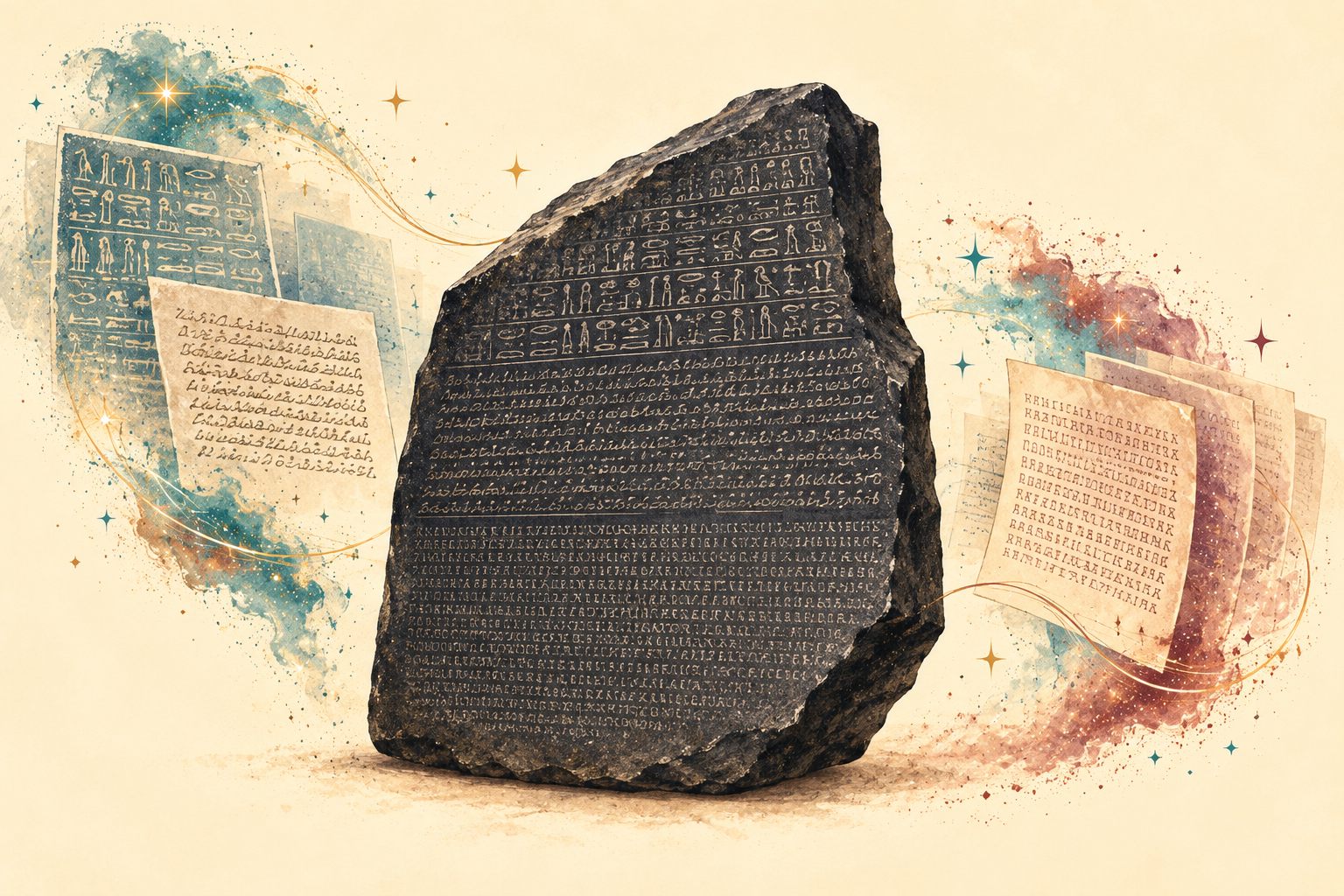
Before the Rosetta Stone became a famous clue, it was part of a document doing a job in Ptolemaic Egypt. In 196 BCE, during the reign of Ptolemy V, priests issued a decree honoring the king and describing religious, political, and administrative arrangements. The decree was ordered in three writing systems: hieroglyphic, Demotic, and Greek.
That original purpose is easy to lose because the object’s later use is so memorable. The Stone is usually introduced as the thing that helped scholars read Egyptian writing. True—but historically out of order. It began as an Egyptian priestly-political document, connected to institutions, observances, royal authority, and the practical problem of presenting one decree across more than one written tradition.
The decoding story is famous because it explains a later transformation. It is not the beginning of the object’s life.
Three scripts, two languages
The first correction is small enough to fit in a margin and important enough to reorganize the whole story: the Stone contains three scripts but two languages.
| Script on the surviving fragment | Language represented |
|---|---|
| Hieroglyphic | Egyptian |
| Demotic | Egyptian |
| Greek writing | Ancient Greek |
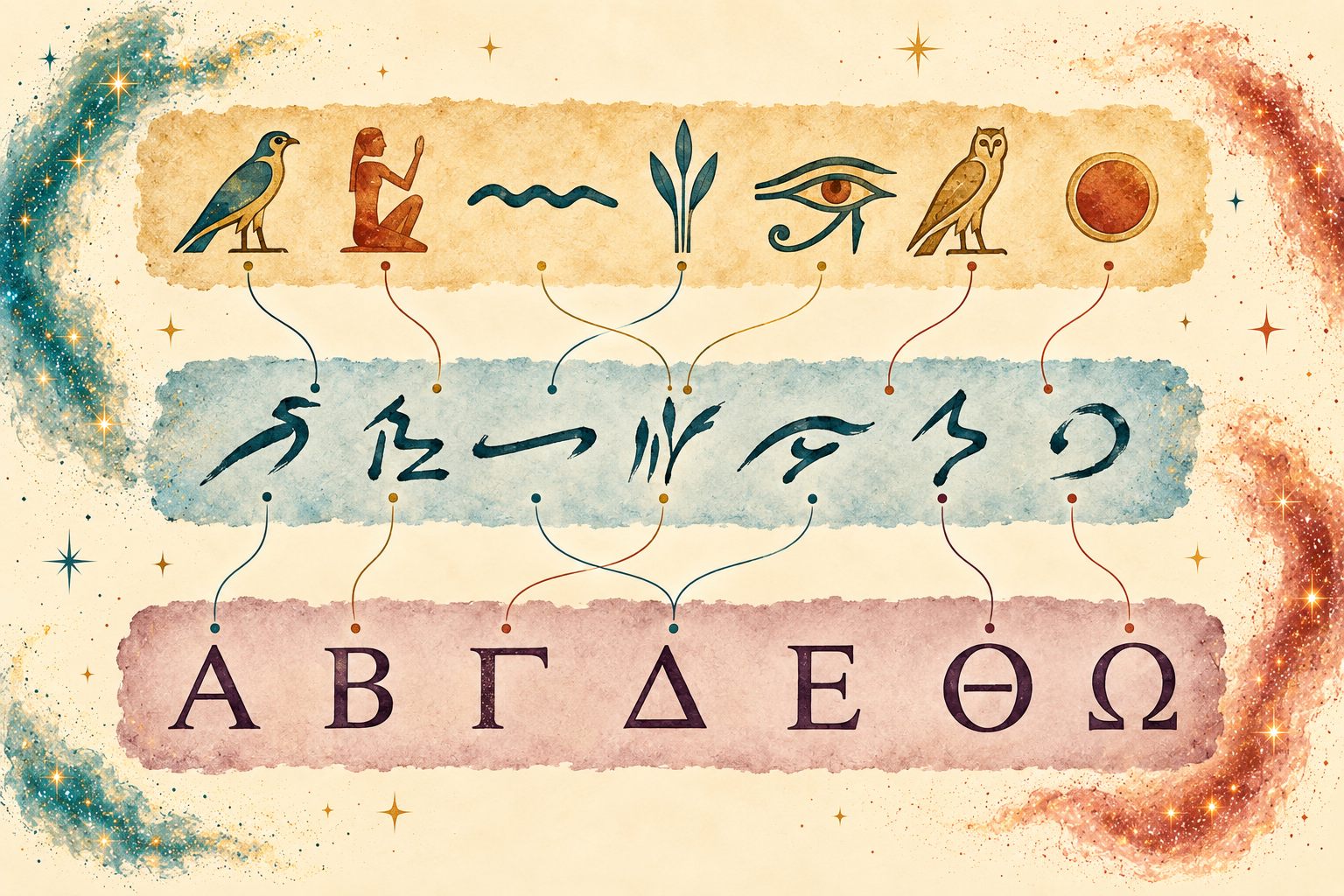
A script is a writing system. A language is the language being written. They are related, but they are not interchangeable labels. The Stone therefore is not three identical translations waiting for a reader to line them up with a ruler. The versions are related, and the surviving object is incomplete. The British Museum records fourteen hieroglyphic lines, thirty-two Demotic lines, and fifty-four Greek lines.
The material has its own correction attached. The current British Museum account identifies the stone as granodiorite. An older British Museum publication calls it basalt. That older word is useful evidence about changing descriptions, but it is not the controlling material identification for this episode.
In other words, even the object arrives with footnotes. History remains committed to making the simple version slightly less simple.
Discovery is a record, not a movie scene
The commonly accepted account places the discovery near Rashid in 1799 during French military construction. The British Museum says the details are vague and identifies Pierre-François Bouchard as recognizing the object’s importance. An older account differs on the month and other details.
That means the responsible version does not invent a perfectly framed discovery scene. It does not decide which uncertain detail sounds most cinematic and quietly promote it to fact. It says what the authorized evidence supports and keeps the uncertainty visible.
Rashid also should not be treated as a location pin attached to a European story. It is a living Egyptian place with its own relationships to the object. The authorized evidence includes a British Museum project documenting participating children in Rashid engaging with local accounts of the Stone, its discovery, and its decipherment. A Cairo Governorate page publicly commemorates discovery and decipherment as well.
These sources establish continuing, bounded forms of engagement. They do not establish one universal Egyptian opinion, and a selected project does not speak for every person in Rashid. The limit is part of the meaning, not a disclaimer stapled on after the interesting bit.
Two routes: the object and the information
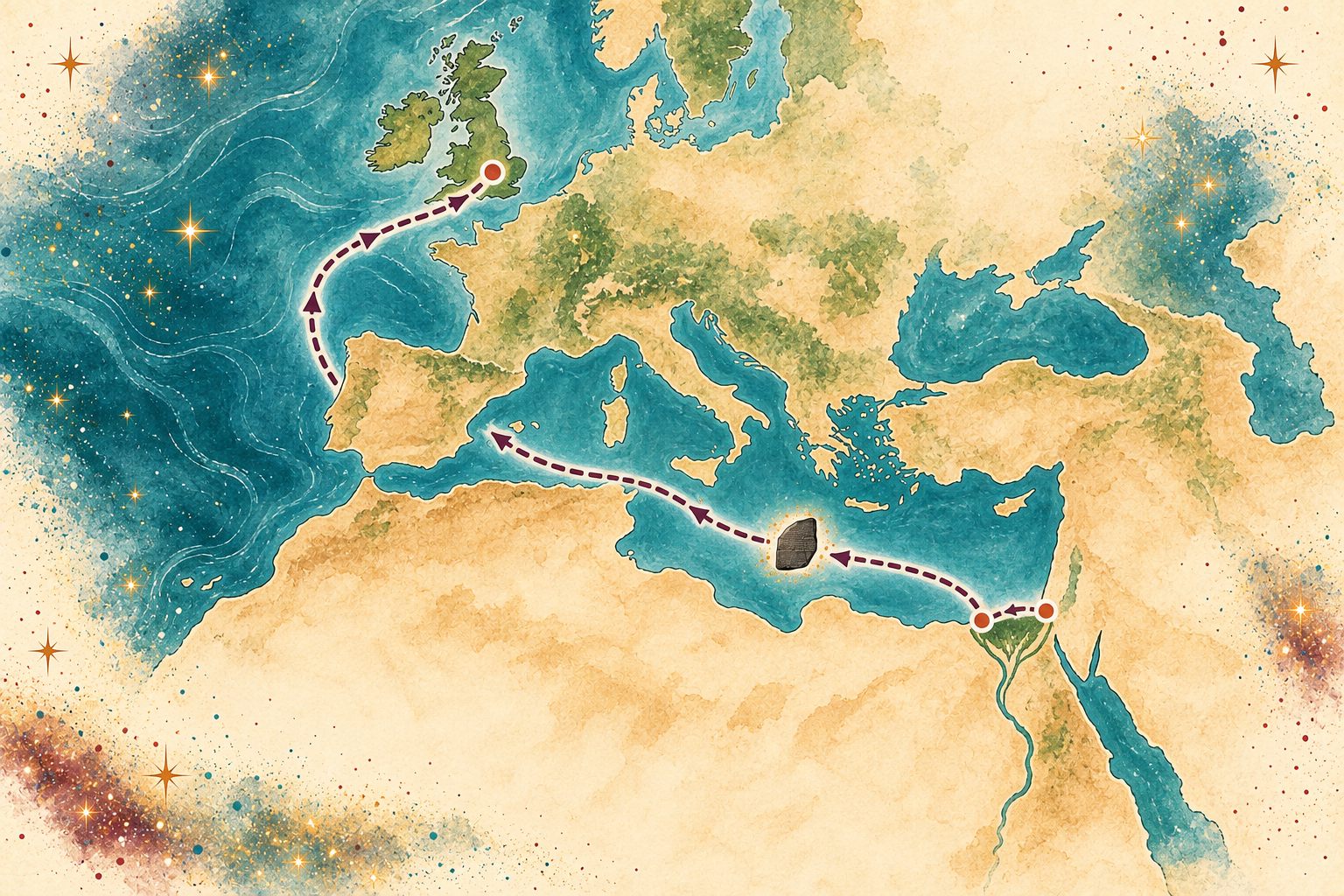
The Stone’s physical history and its research history are connected, but they are not the same route.
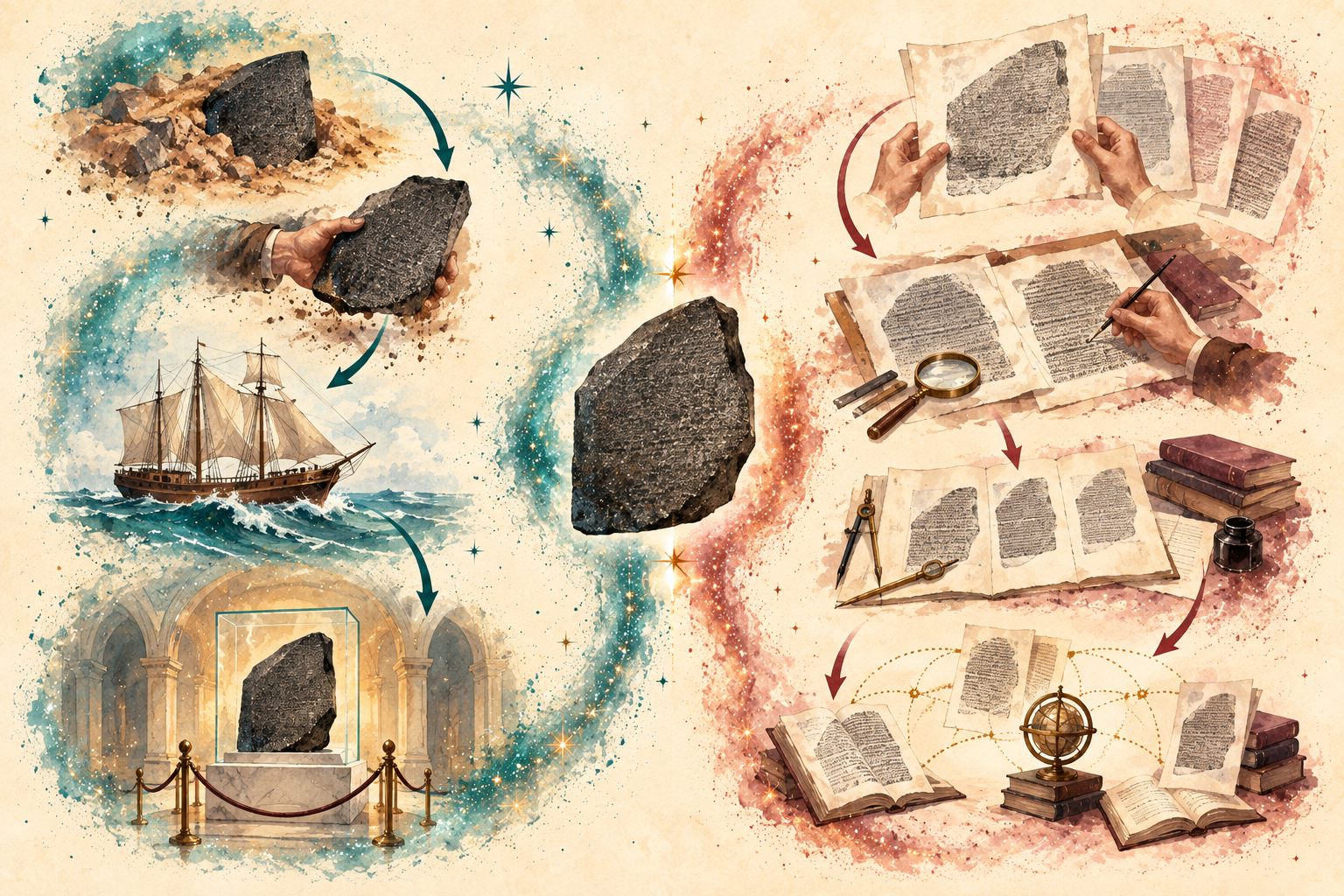
The object route runs through French military activity near Rashid, the 1801 Alexandria surrender terms described by the British Museum and Budge, the object’s arrival in England, and its presentation to the British Museum in 1802.
The information route runs through copies and casts. Reproductions allowed scholars to compare the inscriptions without owning the surviving fragment.
This distinction matters because information can circulate while an object remains under someone else’s control. It also matters because access to a copy is not the same as possessing an answer. A very clear copy can leave you very clearly confused. Anyone who has downloaded an instruction manual and still had to stare at the original object knows the emotional geometry.
The evidence establishes the military custody mechanism described by the holding institution. It does not, by itself, settle ethical legitimacy or tell us comprehensively how Egyptian institutions participated in the custody decision. The current authorized record does not contain a full Egyptian legal analysis or comprehensive public-opinion account.
The method had to leave the Stone
The popular version of decipherment is a lightning strike: the Stone appears, one brilliant scholar understands it, and a lost world becomes readable again.
The documented version is slower, more crowded, and more useful. Earlier scholars worked on Egyptian scripts and Demotic. Coptic, a later form of the Egyptian language, supplied linguistic knowledge. Royal names offered comparison points. Copies and related inscriptions allowed hypotheses to travel. Thomas Young advanced phonetic analysis in royal names. Jean-François Champollion announced a phonetic alphabet associated with royal names in 1822 and developed a broader account of the writing system in 1824. The method had to be tested beyond the Stone.
The important word is cumulative. A contribution can be crucial without being the whole method. A famous object can be decisive evidence without being the only evidence. A publication can mark a breakthrough without erasing the work that made the breakthrough possible.
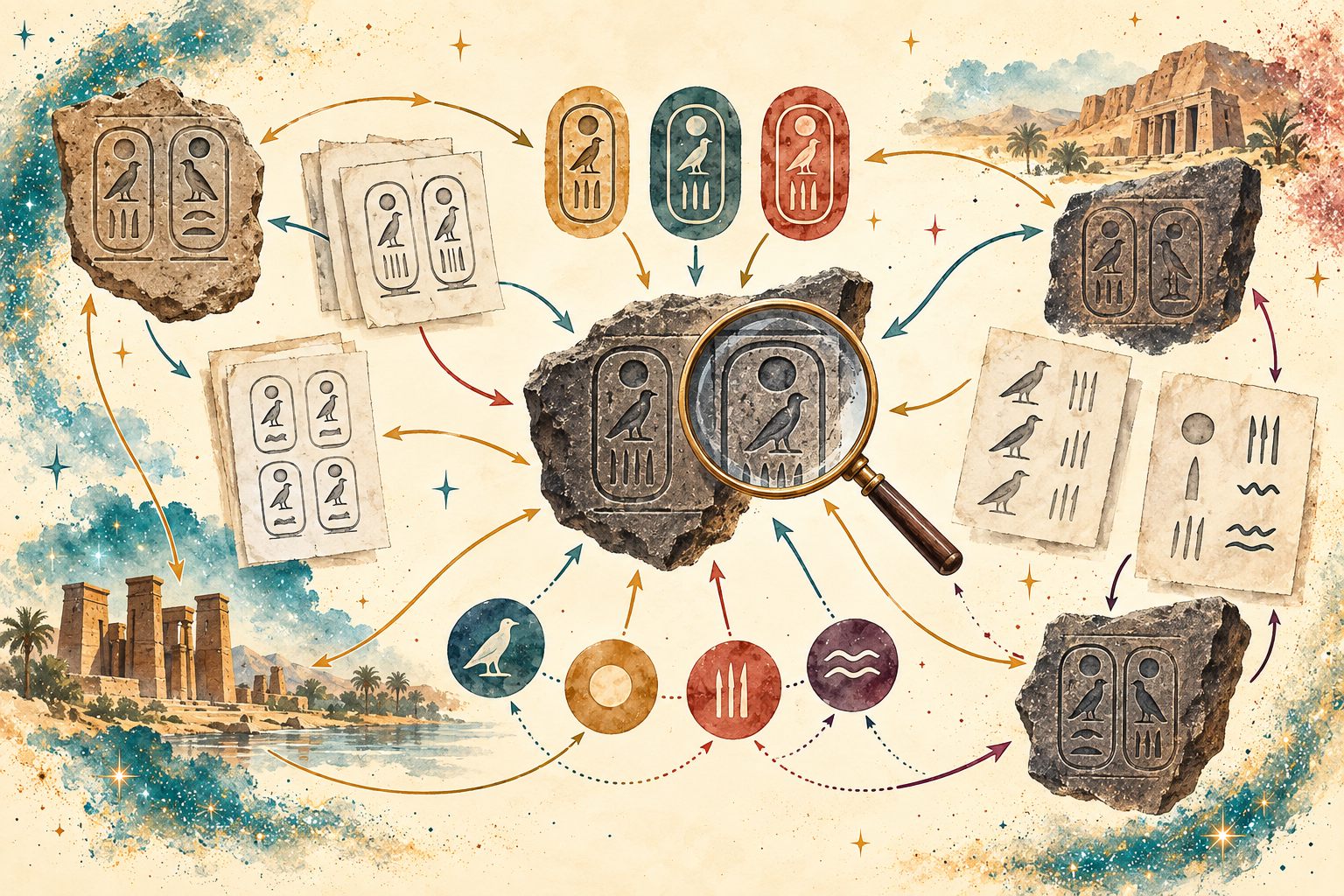
From repeated names to a working system
The problem was not “find the English word under each picture.” Scholars had to work out what kinds of information the signs could carry and how those functions worked together.
A cartouche—an oval enclosing a royal name—could help scholars compare a repeated name across inscriptions. Some signs could carry sounds. Determinatives could add semantic information without functioning as ordinary phonetic letters. Coptic helped scholars test proposed sound relationships and vocabulary.
This is closer to solving a system than matching labels. A proposed reading becomes stronger when it can travel: when it helps explain another name, another inscription, or another combination of sign functions. One attractive match is a beginning. It is not a license to stop comparing.
If a student builds a model that explains one marble rolling down one ramp, the model becomes more convincing when it also explains a steeper ramp, a longer ramp, or a different surface—provided the student says what changed. Decipherment required the same discipline. The analogy stops there: an ancient writing system is not a classroom marble experiment, and historical evidence carries its own languages, institutions, and gaps.
Credit is a map, not a trophy
The authorized source set includes participant accounts, later biographies, French and British institutional framings, and older scholarship. They do not distribute credit in exactly the same way.
Young’s 1823 publication makes a first-person priority claim. Champollion’s work is associated with the 1822 phonetic announcement, the use of Coptic, a broader mixed-system account, and testing across other inscriptions. Earlier contributors, including work on Demotic and the comparative groundwork, also belong in the history.
The fairest explanation assigns contributions by method. It asks who made which move, what source supports that attribution, what remained incomplete, and how later work changed the answer. It does not turn the history into a championship match with one winner and a pile of erased scaffolding. History already contains enough people trying to win arguments; it does not need our help turning every research program into a boxing poster.
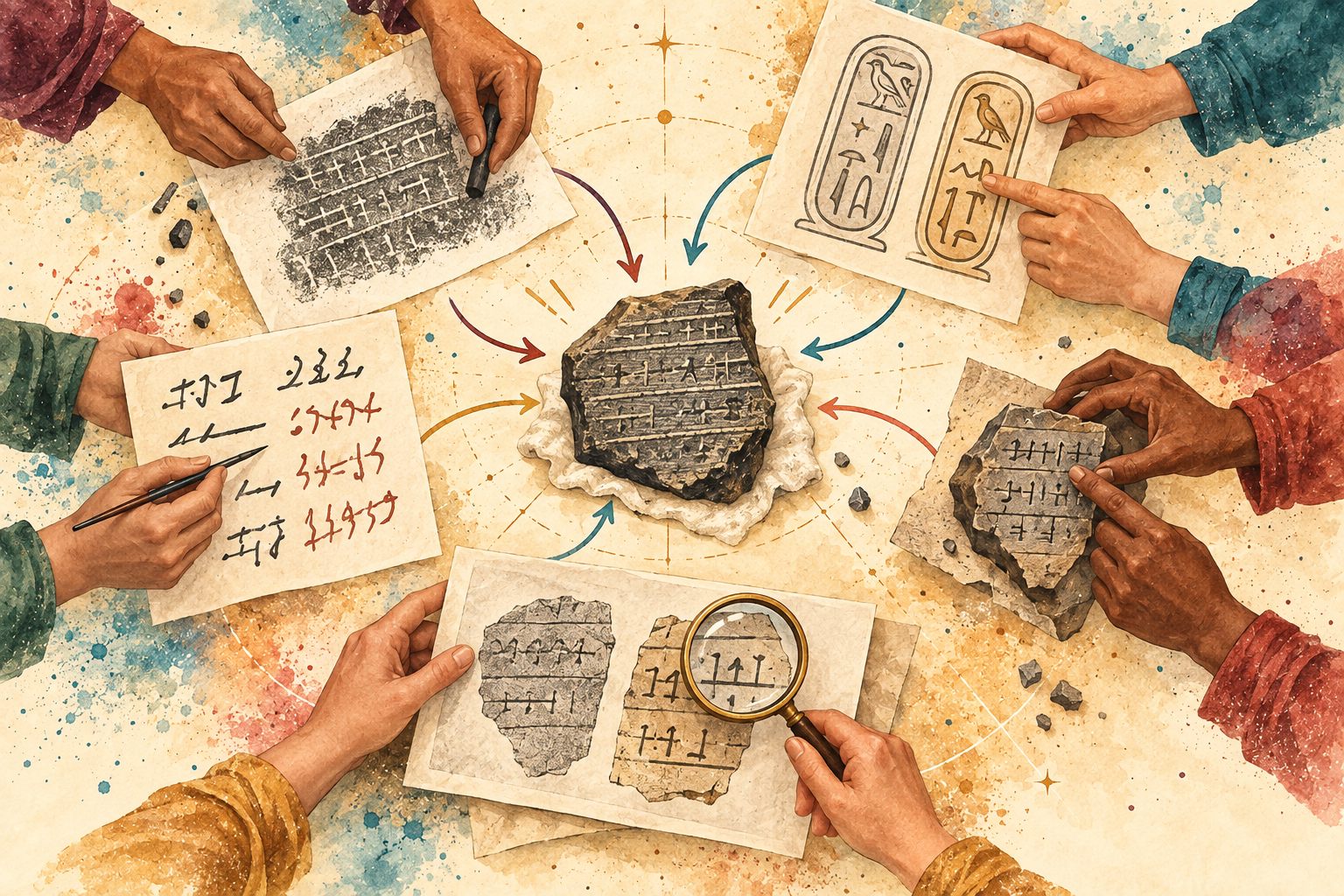
The original purpose remains present
When the Stone became useful to later scholars, it did not stop being a decree. Its later identity as a comparative artifact should add a layer, not flatten the earlier one.
The decree’s religious and political content is not administrative filler waiting for the real story. It records relationships among royal authority, priestly institutions, observances, honors, and public inscription. The survival of that written object made later comparison possible. The later comparison made the object famous. Those are different kinds of importance, and both belong on the page.
The answer, with its scaffolding intact
How did a Ptolemaic decree become evidence for reading Egyptian writing?
It became useful through a network: a surviving multilingual inscription; related copies and casts; language knowledge; royal-name comparison; partial phonetic readings; determinatives; named scholars with overlapping contributions; competing claims about credit; and tests beyond the original fragment. The Stone created an unusually valuable comparative opportunity. The decipherment became reliable through work that exceeded the Stone.
The deeper question is why finished achievements make their scaffolding so easy to overlook. The answer here stays concrete. A decree made for Ptolemaic Egypt became a fragment found amid military activity. The object moved through a military custody story while information moved through copies. Scholars inherited partial methods, revised them, and tested them elsewhere. Later institutions and communities continued to frame and engage with the object, within evidence that remains bounded.
The famous stone is real. So is the work around it.
Explore further
The story above is the article. These resources help you follow its evidence, sequence, people, questions, and classroom connections.
Timeline: when the object and the method changed
| Date | Event | What it establishes | What remains limited |
|---|---|---|---|
| 196 BCE | Ptolemaic priestly decree issued during Ptolemy V’s reign | Original purpose and three writing systems | Translation wording varies |
| 1799 | Discovery commonly placed near Rashid during French military construction | Qualified discovery context | Exact circumstances and month remain uncertain |
| 1801 | Transfer into British possession described through Alexandria surrender terms | Institutional custody mechanism | Not an ethical verdict or complete local-participation account |
| 1802 | Object reaches England; copies and casts circulate | Object and information routes diverge | Circulation does not equal understanding |
| 1810s–1820s | Overlapping comparative and phonetic work | Cumulative method | Priority remains source-framed |
| 1822 | Champollion announces a phonetic alphabet associated with royal names | A public milestone in the decipherment story | Not the entire system in one instant |
| 1823 | Young publishes a retrospective account and priority claim | Evidence of Young’s account and contribution | Not a neutral final allocation |
| 1824 | Champollion develops a broader mixed-system account | Expanded explanation and testing | Work remains cumulative |
| Contemporary | Bounded Rashid project and Egyptian public commemoration | Continuing engagement | Neither represents one universal view |
Related people: contributions, not a trophy
- Ptolemy V: king honored by the decree; the object begins in a Ptolemaic political and priestly context.
- Priests at Memphis: institutional actors associated with issuing the decree; do not reduce them to background scenery.
- Silvestre de Sacy and Johan David Åkerblad: associated with earlier Demotic and proper-name work in the authorized history.
- Thomas Young: advanced phonetic analysis in royal names and later published a first-person priority account.
- Jean-François Champollion: associated with the 1822 phonetic announcement, Coptic, the broader mixed-system account, and testing across inscriptions.
- Pierre-François Bouchard: identified by the British Museum as recognizing the object’s significance; discovery details remain qualified.
Evidence cards: how we know what we know
Each source should be read for both what it supports and where its perspective limits the claim.
- The decree translation: supports content, inscriptions, and institutional purpose. A translation is derivative and not the only possible rendering.
- Young’s 1823 account: supports Young’s published chronology and priority claim. It is a participant account, not a neutral verdict.
- British Museum object overview: supports material, line counts, discovery qualification, and custody description. It is an institutional account.
- Budge, 1929: supports older custody and decipherment framing, while preserving the outdated basalt terminology as historical source evidence.
- Rashid project: supports a bounded example of local engagement, not collective representation.
Curiosity trails
- What surviving records could narrow the uncertainty around the 1799 discovery?
- How should credit be allocated across Demotic work, royal-name comparison, phonetic analysis, Coptic, mixed-system explanation, and testing?
- Which Egyptian institutional or community records could add to the custody history?
- What broader range of Rashid perspectives exists beyond the bounded project?
- What can be established about the missing portions of the larger stela without inventing a reconstruction?
Discussion questions
- Why should the decree’s original purpose appear before its role in decipherment?
- What is gained—and what is lost—when the story is told as “one stone, one genius”?
- How do the object route and information route differ?
- Why is Young’s priority claim useful evidence without being a neutral verdict?
- What does the custody record establish, and what does it leave open?
- Which source would you want to inspect next, and what question would it help answer?
Learning materials
Explore the companion student activities and teacher resources for this episode on the Rosetta Stone learning materials hub.
Sources
This article draws on the authorized episode source set. These linked sources support the article’s account of the Stone, its decree, decipherment, custody, and continuing reception.
- British Museum — Everything you ever wanted to know about the Rosetta Stone
- British Museum — Eureka! Finding the key to ancient Egypt
- British Museum — Egyptian hieroglyphs decipherment timeline
- Louvre — Champollion: The path to hieroglyphs
- Thomas Young — Account of Some Recent Discoveries in Hieroglyphical Literature and Egyptian Antiquities
- Fordham University — Rosetta Stone decree translation
- UCL Digital Egypt — House of Life sources
- Thomas Young — Memoir of the discovery of the Rosetta Stone
- E. A. Wallis Budge — The Rosetta Stone
- British Museum — Children of Rashid
- Cairo Governorate — Deciphering the Rosetta Stone
This article draws on the authorized episode source set, including British Museum object and decipherment materials, Louvre Champollion materials, Thomas Young 1823 materials, Ptolemaic decree context, a hosted decree translation, older British Museum scholarship, a British Museum Rashid project, and a Cairo Governorate public-history page. Source positions and uncertainty limits are disclosed rather than flattened into one institutional voice.
This World Explained · How our world became this way · thisworldexplained.com
Chapters
Chapters are added when the episode is published.
Transcript
The speaker-identified transcript is published on this page with the episode. A written adaptation of the audio is a separate piece with its own sources — not a copy of this transcript.
Episode credits
- Presented by
- Bridget Zayner
- Published
- Series
- Tales That Shaped Us
- Transcript
- Human-checked before publication